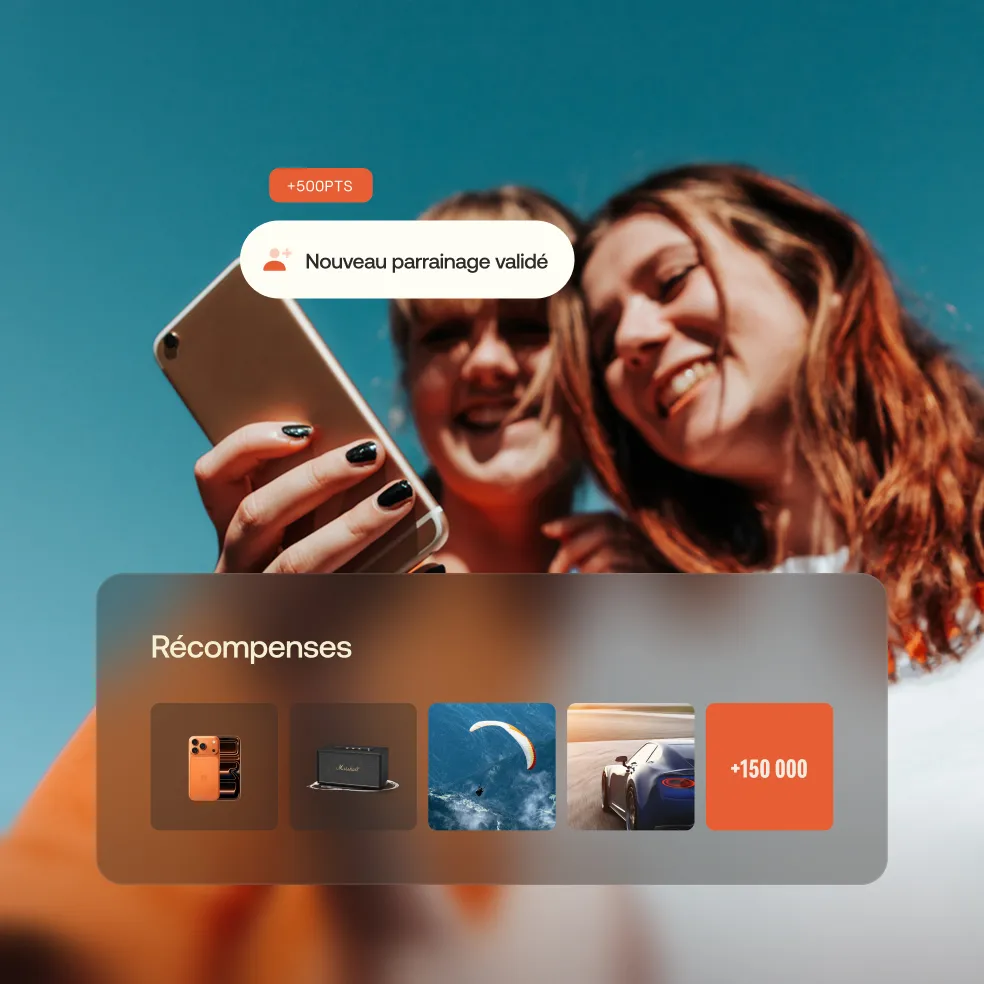
With changing regulations, acquisition is shifting toward a consent-based model, making traditional approaches less relevant. Referral programs are emerging as an effective and naturally compliant lever, relying on customer recommendations. To be successful, they must remain simple, well-rewarded, and activated at the right time. More broadly, this reflects a shift toward more qualitative and relationship-driven acquisition strategies.
Today, the rejection is massive: 97% of French people say they are annoyed by cold calling. Above all, the legal framework is evolving rapidly. Starting in August 2026, telephone prospecting will move to an opt-in model: without explicit consent, it will no longer be possible to contact an individual.
From Bloctel to opt-in: the end of an era
For years, the principle was simple: the system was based on opting out. Consumers had to take the active step of registering on a Bloctel list to signal their refusal to be "prospected."
This barrier proved to be ineffective, as the very principle of asking citizens to sign up for a list that was ignored by most telemarketers was doomed to fail.
Starting August 11, 2026, the principle will be opt-in.
No company will be able to cold call an individual without first obtaining their "free, specific, informed, unambiguous, and revocable" consent. The burden of proof will now lie with the company, which must be able to demonstrate that this agreement exists. For Bloctel, supplanted by a general prohibition (except with express authorization), the party is over.
This change goes far beyond a simple regulatory adjustment. It marks the end of forced acquisition and requires companies to fundamentally rethink their practices.
A structural transformation of acquisition
What the regulation confirms is a shift that has already begun on the consumer side. Attention is no longer captured by force. It is built. In this new framework, several changes are becoming unavoidable:
- a requirement for explicit and traceable consent
- increased pressure on "cold" channels
- shifting performance toward intentional interactions
The goal is no longer to increase the number of contacts, but to maximize the quality of every relationship initiated.
Why referral marketing is evolving
In this context, referral marketing is no longer a secondary lever. It directly addresses new market constraints. The principle is simple: the relationship is not initiated by the brand, but by a customer. This starting point profoundly changes the acquisition dynamic.
In practical terms, referral marketing allows you to:
- leverage a voluntary recommendation
- benefit from an already established level of trust
- reduce friction when starting a relationship
It therefore fits naturally into a consent-based approach while remaining highly effective.
A powerful lever… but one that requires oversight
Referral marketing is not exempt from regulatory frameworks. Certain mechanics can quickly become sensitive if they are poorly structured.
The main points of vigilance concern:
- the compensation structures based on recruitment
- the multi-level structures
- the lack of transparency in the terms and conditions
In such cases, these schemes may be reclassified or even deemed prohibited pyramid schemes.
Beyond these risks, the fundamentals remain the same as for any marketing initiative:
- clear and accessible rules
- a clear value proposition
- rigorous management of personal data
An effective referral program relies as much on its design as it does on its execution.
What really makes the difference
Setting up a referral program is simple. Turning it into a sustainable acquisition channel is much less so. Three structural elements generally make the difference:
1. Simplicity of the system
A smooth, frictionless journey is a direct prerequisite for usage. If the mechanism is complex, it will not be adopted.
2. The perceived value of the reward
The reward must be genuinely desirable. It should not be seen as mere compensation, but as a real experience or benefit.
3. The right time to activate
Referral programs work best when offered at the peak of customer satisfaction. That is when recommendations become natural.
Towards more controlled acquisition
What is at stake today goes beyond the subject of referrals alone. The entire landscape of acquisition strategies is shifting toward a more qualitative model. Less volume, more relevance. Less interruption, more connection. Less pressure, more recommendation.
In this context, referral programs emerge as a coherent solution. Not as a passing trend, but as a logical evolution, aligned with both consumer expectations and regulatory requirements.
Companies that anticipate this shift are doing more than just ensuring compliance. They are building systems that are more effective, sustainable, and better received.
So, what does this look like in practice?
Setting up a referral program is not just about adding a reward mechanism. It is about structuring a full-fledged acquisition channel that can stand the test of time, integrate into your marketing ecosystem, and remain compliant within an increasingly demanding regulatory framework.
This is precisely the approach we have developed at RewardPulse, with a turnkey cumulative referral program, designed to turn customer satisfaction into a true engine for acquisition.
The goal is not just to trigger occasional referrals, but to create a continuous system where every customer can gradually become an active brand ambassador. This requires a well-calibrated incentive structure, a seamless experience, and regular program engagement to maintain momentum over time.
Designed as a comprehensive solution—including the platform, rewards, engagement, and legal framework—referral marketing becomes more than just a channel: it is a structured, measurable, and sustainable lever for scaling your acquisition.
Prêts à booster vos ventes ?
Lorem Lipsum Pain Sits Amet, Conecteur adipiscing Elite. Suspend varius enim in eros elementum tristique. Suis cursus, mi quivera ornare, eros pain interdum nulla, tu commodo diam libero vitae erat. Aenean Faucibus nibh et justo cursus di rutrum lorem imperdiet. Nunc ut sem vitae rissus sad powder.
request a demo.webp)