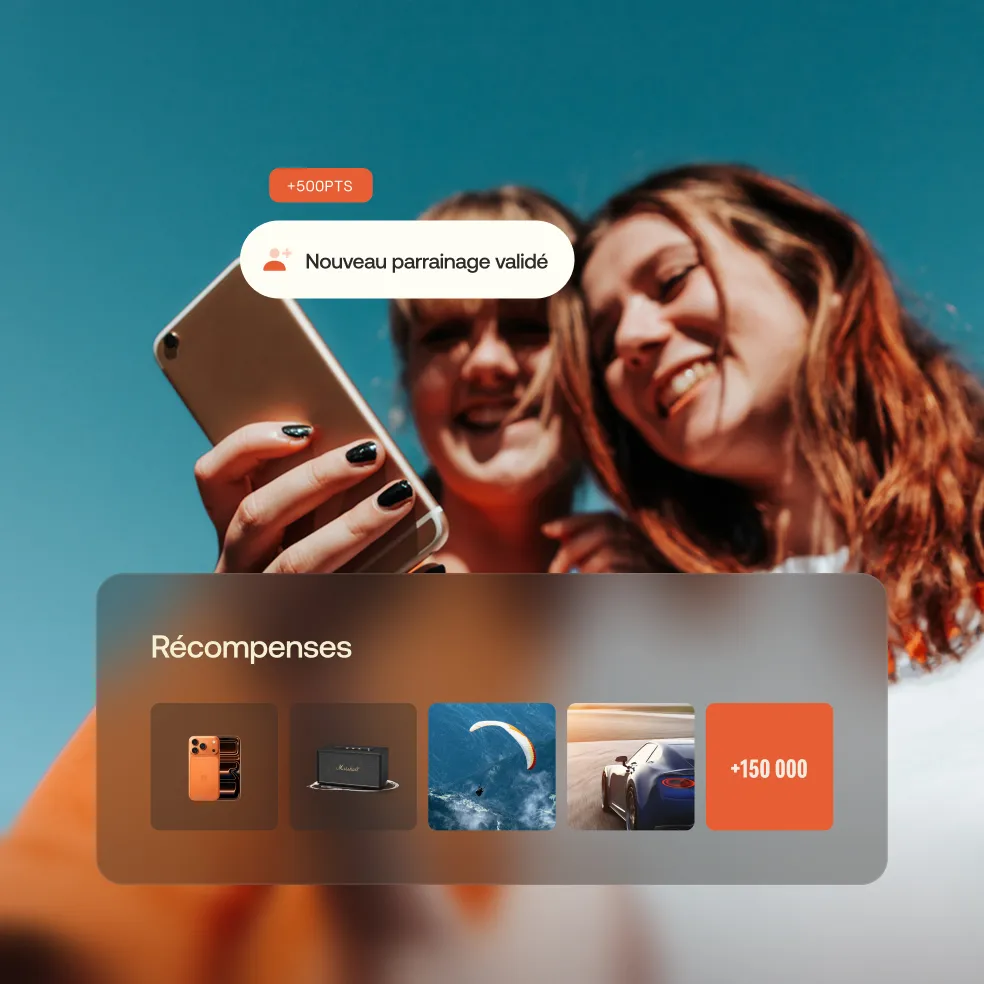
B2B customer loyalty cannot simply be an adaptation of B2C tactics.
The challenges are different:
- long decision-making cycles,
- multiple stakeholders,
- a dominant economic rationale,
- and a specific regulatory framework.
In 2026, the landscape is shifting further:
- stricter oversight,
- changing social thresholds,
- and tighter regulation of certain commercial practices.
Implementing a B2B loyalty program is therefore not just about handing out points or rewards. It is about building a strategic framework that is profitable from the very first euro invested, legally secure, and perfectly aligned with your business objectives.
In this comprehensive guide, you will discover:
- the precise definition of B2B customer retention,
- its fundamental differences from B2C,
- the objectives it can serve,
- and why it is now a direct driver of growth and profitability.
What is B2B customer retention?
Defining B2B customer retention
B2B customer retention refers to all the strategies and mechanisms implemented by a company to strengthen, extend, and monetize its relationships with professional clients.
Unlike B2C, retaining professional clients relies less on emotion and more on:
- the economic value created,
- operational performance,
- service quality,
- and the strength of the business relationship.
A B2B loyalty program can take several forms:
- points-based systems (earn & burn),
- deferred discounts or VIP status,
- reseller incentives,
- exclusive benefits,
- premium services,
- access to restricted content,
- professional or experiential rewards.
Its goal is not just to reward past purchases, but to influence future behavior: increasing volume, order consistency, product range diversification, and relationship engagement.
B2B vs. B2C loyalty: what are the differences?
Although both approaches share similar mechanisms (points, rewards, benefits), their underlying logic is fundamentally different.
In B2C, loyalty relies heavily on emotional and behavioral drivers: purchase frequency, brand attachment, and immediate gratification.
In B2B, the logic is primarily economic. Every decision impacts a structure, a margin, or a resale or operational cycle. Professional clients do not buy to consume; they buy to create value.
B2B loyalty must therefore be part of a clear business equation:
- contribution to revenue,
- margin improvement,
- portfolio security,
- competitive positioning.
It also involves greater structural complexity: multiple stakeholders, long sales cycles, segmentation by account type, and multi-user management. The system must be designed to integrate into an existing commercial ecosystem (CRM, distribution network, sales force) rather than operating in a silo.
Finally, B2B introduces a specific regulatory dimension. Rewarding an individual consumer does not have the same implications as rewarding an employee, a freelancer, or a reseller. Social and tax compliance becomes a structural parameter in program design.
B2B loyalty is therefore not just an adaptation of B2C. It is a discipline in its own right, at the intersection of marketing, sales, and financial performance.
Why is B2B loyalty a growth lever?
A B2B loyalty program has only one justification: generating measurable additional revenue.
Unlike some B2C approaches where profitability may be diluted by brand awareness or customer experience, in B2B, a program must be profitable. It must be designed from the outset as an investment indexed to expected growth.
A well-structured system acts simultaneously on several levers:
- increasing purchase frequency,
- raising the average order value,
- shifting toward higher-margin product lines,
- securing strategic accounts,
- reducing churn,
- driving competition within distribution networks.
For companies that master the design, operationalization, and management of their program, the impact can represent several points of organic growth. In the field, the most successful programs can generate up to 10%, 15%, or even 20% in additional revenue when properly scaled.
The key lies in the investment logic: you don't define a budget to be spent, but a growth target to be achieved. The program is then calibrated based on the targeted revenue increase, with a proportionate reward mechanism.
In other words: B2B loyalty is not a cost center. It is a structured performance lever that must be profitable from the very first euro invested.
The objectives of a B2B loyalty program
The right approach is to define the economic problem the program is intended to solve. In a professional context, there are generally four main categories of objectives.
1. Securing existing revenue (defensive objective)
Before looking to grow, you must stabilize.
In many B2B sectors (manufacturing, trading, technical services), competitive pressure is intense and products are often interchangeable. The primary risk is not a lack of new customers, but the gradual loss of wallet share.
A B2B loyalty program can be used to:
- lock in strategic accounts,
- limit volatility,
- secure minimum volumes,
- reduce the temptation of competitors.
Associated KPIs
2. Generate additional revenue (offensive objective)
This is where B2B loyalty programs reveal their greatest potential.
A well-calibrated program explicitly targets measurable increases:
- +5% purchase frequency
- +10% average order value
- +15% product mix
- +20% on priority ranges
The goal is not to reward the past. It is to drive future behavior.
This involves:
- progressive tiers,
- bonuses on strategic products,
- challenge mechanics,
- ongoing engagement.
In the most successful programs, the increase in incremental revenue can represent up to 10 to 20%, provided the initiative is designed as a structured investment.
A B2B loyalty program must be profitable.
It is calibrated to a predefined growth target.
3. Improving margins and revenue quality
Not all revenue is created equal.
A program can target:
- shifting focus toward premium ranges,
- reducing low-margin products,
- leveraging complementary services,
- upselling.
Customer retention thus becomes a strategic decision-making tool.
4. Activate relational and community engagement
In B2B, the relationship matters as much as the transaction.
A program can include:
- referrals,
- testimonials,
- event participation,
- ongoing training,
- exclusive content.
The goal is twofold:
- Increase customer lifetime value (LTV)
- Turn select accounts into ambassadors
How do you build an effective B2B retention strategy?
A high-performing B2B retention strategy is about more than just a points program or a rewards catalog.
It is built on a precise strategic framework, designed upfront to serve a clear economic objective.
Designing an effective program requires answering four key questions:
- Who do you want to engage?
- What behavior do you want to influence?
- What incentive structure is most relevant?
- How do you ensure profitability and compliance?
1. Segment before you reward
One of the most common mistakes is offering a one-size-fits-all program to your entire customer base.
In B2B, account value is extremely varied.
An effective strategy begins with strategic segmentation:
- high-value strategic accounts,
- accounts with growth potential,
- transactional accounts,
- dormant accounts to reactivate,
- resellers or distributors to incentivize.
Loyalty efforts must be proportional to the account's actual or potential value.
The higher the revenue contribution, the more personalized and differentiated the benefits should be. Conversely, a program that is too generous for low-value accounts will dilute overall profitability.
Segmentation is not about marketing.
It is about finance.
2. Define the target behavior
An effective B2B loyalty strategy does not reward the purchase itself.
It rewards a specific behavior.
Examples:
- increasing purchase frequency,
- reaching a volume threshold,
- prioritizing a strategic product line,
- diversifying the portfolio,
- signing a framework agreement,
- participating in product training,
- referring a new client.
Every program must be built around a priority lever.
The clearer the targeted behavior, the more effective the incentive mechanism will be.
3. Design a consistent incentive mechanism
The program design must translate the strategic objective into an economic equation. There are generally three main architectures in B2B loyalty:
a) Points-based programs (earn & burn logic)
The customer accumulates rewards based on their actions (revenue, frequency, engagement) and then converts them into benefits.
👍 Pros:
- clarity,
- precise control over generosity,
- flexibility.
👎 Cons:
- requires regular engagement to maintain interest.
b) Status or tier-based programs
The customer reaches a level (Silver, Gold, Premium, etc.) based on their volume of activity.
👍 Pros:
- strong psychological impact,
- visible differentiation,
- natural retention.
👎 Limitation:
- must remain accessible to avoid frustration.
c) Ad-hoc incentives
Time-bound challenges with bonuses for specific products or volumes.
👍 Benefits:
- rapid impact,
- targeted activation,
- direct commercial effect.
👎 Limitation:
- less effective for long-term structure.
In practice, the most successful strategies combine:
- a continuous relationship base (permanent program),
- ad-hoc activations (incentives, bonuses, challenges),
- regular engagement.
4. Define the program's business model
B2B loyalty is not just a marketing campaign.
This is a financial model.
Before any launch, you should determine:
- the expected additional revenue,
- the margin generated,
- the maximum acceptable reward rate,
- the technology cost,
- the promotional budget.
A simple principle applies: the reward must always be proportional to the value created.
In other words, the program must be calibrated to remain profitable from the very first euro invested.
5. Integrate compliance by design
In B2B, compliance is not a secondary issue.
Depending on the type of beneficiaries (companies, freelancers, external employees), the social and tax implications vary.
An effective strategy includes:
- formalized consent,
- validated terms and conditions,
- traceability of rewards,
- structuring rewards (gift vouchers vs. cash),
- optimizing regulatory thresholds.
Compliance is not just an administrative burden.
It is a fundamental element of program design.
To learn more, watch the replay of our webinar: "B2B Loyalty & Incentives: What you are allowed to do in 2026".
.webp)
6. Plan your engagement strategy from the start
A B2B loyalty program without engagement is a dormant program.
Performance depends on:
- communication frequency,
- message personalization,
- targeted follow-ups,
- highlighting benefits,
- visibility of milestones reached.
Loyalty is a dynamic process.
Without continuous activation, even the best mechanics will lose steam.
7. Monitor, measure, adjust
An effective B2B loyalty strategy relies on precise metrics:
- activation rate,
- average order value growth,
- purchase frequency,
- growth in strategic product lines,
- net program profitability.
Monitoring should allow you to adjust rewards, optimize tiers, correct unexpected behaviors, and maximize return on investment.
How do you measure the ROI of B2B loyalty?
Calculating return on investment is based on a simple equation:
Additional revenue generated – total program cost = net value created
The total cost includes:
- rewards or incentives,
- technology (platform),
- engagement and communication,
- any applicable social or tax charges.
The key is not the absolute cost, but the ratio between the value created and the investment made.
Example 1: 25% increase in a targeted segment
Imagine an industrial company with a portfolio of installers generating €5,000,000 in annual revenue.
Goal: increase purchase frequency and recurrence through a structured program.
After program deployment:
- Segment revenue: €6,250,000
- Growth: +25%
- Additional revenue: €1,250,000
- Total program cost: €250,000
In this scenario, every euro invested generates 5 euros in additional revenue. Even when accounting for actual margins, the program remains structurally profitable.
Example 2: stimulating a hospitality network
In another case, a company operating in the café and restaurant sector deploys a program designed to boost sales among a specific target group.
Results observed over the period:
- +30% in additional sales within the activated segment.
The logic is the same: the program does not reward existing purchases; it changes purchasing behavior by creating positive competitive momentum.
Average projections observed for structured programs
For programs that are properly segmented, managed, and monitored, the impact can represent:
- 10% to 20% additional revenue from the activated segment,
- improved product mix,
- reduced churn,
- secured strategic accounts.
Implement a profitable B2B loyalty program with RewardPulse
At RewardPulse, we design and deploy B2B loyalty programs built around a simple principle:
no project is launched without first validating its projected profitability.
Our approach is based on:
- a strategic analysis of your client portfolio,
- modeling of the expected additional revenue,
- design that complies with tax and social regulations,
- a technology platform dedicated to B2B (multi-account, multi-user),
- performance-driven management and engagement.
Discover our B2B loyalty offering and let’s discuss modeling a program tailored to your growth objectives.
Prêts à booster vos ventes ?
Lorem Lipsum Pain Sits Amet, Conecteur adipiscing Elite. Suspend varius enim in eros elementum tristique. Suis cursus, mi quivera ornare, eros pain interdum nulla, tu commodo diam libero vitae erat. Aenean Faucibus nibh et justo cursus di rutrum lorem imperdiet. Nunc ut sem vitae rissus sad powder.
request a demo%20(10).png)
.webp)