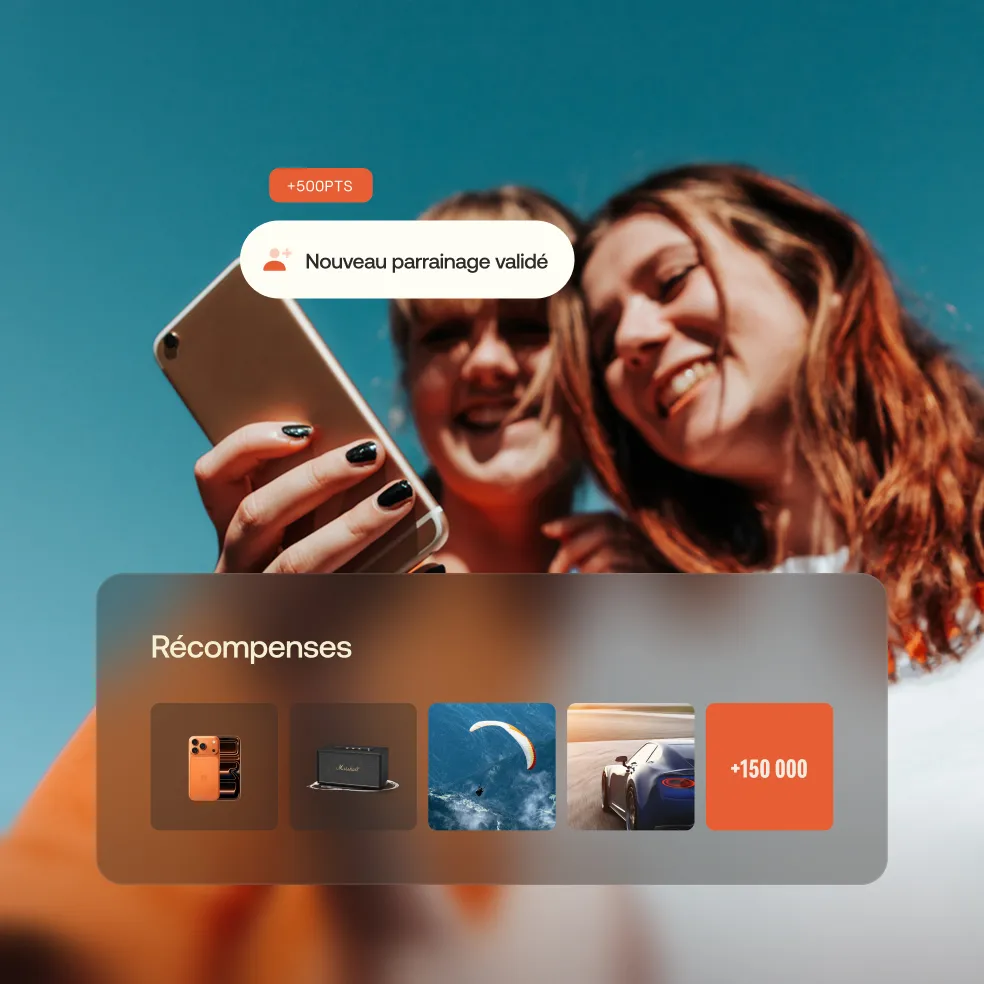
Referral programs have become an essential strategy for acquiring new customers while retaining existing ones. But how do you create an effective referral program that reflects your brand's values? Discover everything you need to know about this marketing technique and why it is essential for boosting your growth.
What is a referral program?
A referral program is a marketing strategy based on word-of-mouth: your satisfied customers become brand ambassadors by sharing their experience with their network. In exchange for this recommendation, both parties – the referrer (your existing customer) and the referee (the new customer) – receive a reward.
This approach is built on a fundamental marketing principle: trust. Unlike traditional advertising, which must convince a skeptical consumer, referrals rely on the pre-existing relationship between two individuals, making the recommendation more credible and effective.
Key elements of a referral program
- An attractive reward The heart of any referral program is the reward. It needs to be attractive enough to motivate your customers to act, while also aligning with their expectations. This could be discounts, experiences, physical gifts, or even loyalty points.
- A simple and fast process To maximize engagement, it is crucial that the program is easy to understand and use. This can include unique links, QR codes, or direct integrations within a mobile app.
- Effective tracking and measurement Referral programs require precise tracking to prevent abuse and measure effectiveness. This includes tracking referrals, analyzing conversions, and calculating ROI.
How does a referral program work?
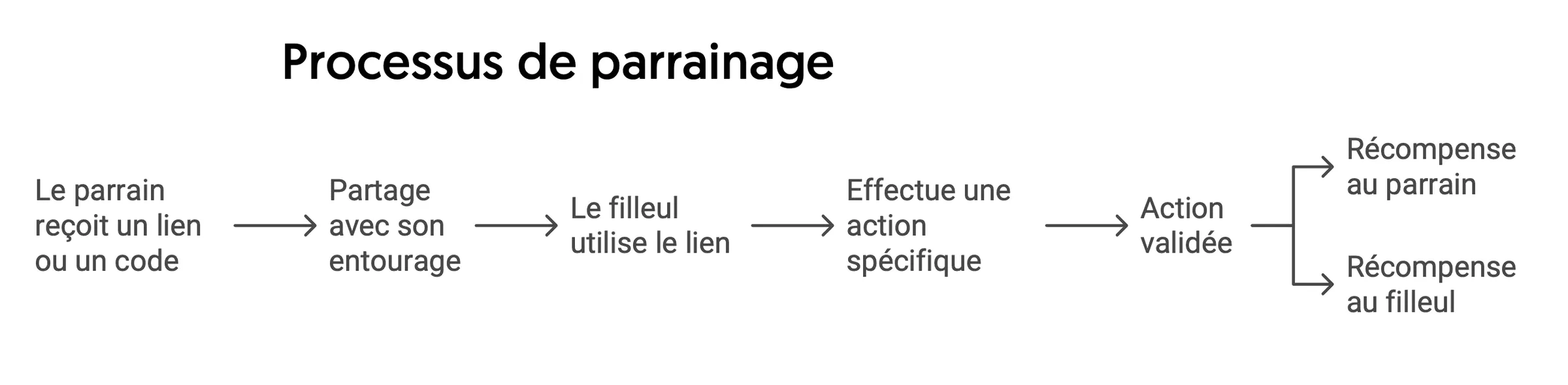
A referral program generally follows these steps:
- Invitation : The referrer receives a link or code that they can share with their network.
- Referee action : The referee uses the link to complete a specific action (purchase, sign-up, etc.).
- Reward : Once the action is verified, the referrer and/or the referee receive a pre-defined reward.
Difference from other marketing strategies
A referral program differs from strategies like influencer marketing or affiliate marketing. While the latter often involve third parties (influencers or partners) to promote a brand, referrals rely solely on existing customers.
Why do referral programs work so well?
Personal recommendations are perceived as much more reliable than other forms of marketing communication. A Nielsen study reveals that 92% of consumers trust recommendations from friends and family over advertising. Furthermore, customers acquired through a referral program often have a higher lifetime value (Customer Lifetime Value) and are more likely to remain loyal.
Why implement a referral program?
A referral program is much more than just a simple marketing tool : it is a powerful strategy that can transform your customer relationships, strengthen your brand, and generate sustainable growth. Here is why a referral program is essential for any ambitious business.
Lower customer acquisition costs
Acquiring new customers often represents one of the largest budget items for a company. Paid advertising, multichannel marketing campaigns, and expensive partnerships—while effective—require a significant investment.
With a referral program, this cost is drastically reduced. By leveraging recommendations from your existing customers, you benefit from an acquisition lever based on word-of-mouth, which is considered one of the most effective ways to convince new customers.
Key figure: Customers acquired through referrals cost 78% less than those obtained through traditional advertising campaigns.
Source: Hubspot
Furthermore, customers acquired through recommendations tend to convert faster and have a higher average order value, which boosts the profitability of the initiative.
Strengthening existing customer loyalty
A referral program does more than just recruit new customers: it also adds value for your current ones. By rewarding their recommendations, you encourage them to engage more deeply with your brand and maintain a long-term relationship.
This recognition creates a virtuous cycle:
- Loyal customers feel valued and want to deepen their commitment.
- They become true brand ambassadors of your brand, actively recommending your products or services to those around them.
A well-designed referral program turns your customers into strategic partners in your success.
Increased credibility through personal recommendations
In a market saturated with offers, consumer trust in traditional advertising is declining. Personal recommendations, however, remain one of the most reliable sources of information.
- Key figure : 92% of consumers trust recommendations from friends and family more than advertising. (Source: Hubspot)
A referral program leverages this trust capital. When a customer recommends your product or service, their network is much more likely to try it. This dynamic not only increases your conversions but also enhances your brand image.
Improved brand awareness
Every time a customer recommends your product or service, they amplify the visibility of your brand. By sharing their referral link via social media, email, or word-of-mouth, your existing customers help introduce your business to audiences you might never have reached otherwise.
Furthermore, a well-integrated referral program can turn your ambassadors into micro-influencers, giving your brand a greater presence within trusted circles.
Increased long-term customer value
Customers acquired through referrals often have a lifetime value (Customer Lifetime Value) higher than that of customers acquired through other channels. This is due to several factors:
- They begin their relationship with your brand on a foundation of trust, thanks to the recommendation.
- They are more likely to remain loyal, as their initial experience is often positive.
- They are often inclined to become advocates themselves, further strengthening the program's momentum.
A flexible and customizable tool
A referral program adapts to almost any industry or business model. Whether you are in B2C, B2B, or SaaS, you can tailor your program to your target audience:
- For a luxury brand: offer premium experiences.
- For a tech startup: offer credits or free features.
- For a local small business: focus on discounts or physical gifts.
This flexibility allows you to align the program with your overall strategy, your goals, and the specific expectations of your customers.
In short: a winning strategy
A referral program is a strategic tool with multiple benefits:
- Lower acquisition costs.
- Stronger customer loyalty.
- Increased brand awareness.
- Improved long-term profitability and growth.
By capitalizing on the trust and engagement of your existing customers, you turn every recommendation into an opportunity for sustainable growth.
How do you set up an effective referral program?
A well-designed referral program can become a powerful lever for acquiring new customers and retaining existing ones. But to maximize its impact, it is essential to follow certain key steps. Here is a detailed guide to creating an effective referral program that aligns with your goals.
1. Define clear objectives
Before launching a program, identify what you want to achieve. Your goals will guide strategic decisions and allow you to measure the success of your initiative.
- New customer acquisition : Grow your customer base by leveraging word-of-mouth.
- Retention : Reward your existing customers to strengthen their loyalty to your brand.
- Revenue growth : Boost sales by expanding your customer base.
- Brand awareness : Increase your company's visibility to a wider audience.
Goals must be measurable and specific to effectively evaluate the program's results.
2. Identify your target audience and tailor your program
Every referral program should be designed with your target audience in mind:
- For a younger demographic : Integrate digital solutions like QR codes, apps, or digital rewards (subscriptions, gift cards).
- For a premium clientele : Offer exclusive experiences or high-end products that reflect your brand image.
- For B2B companies : Provide professional benefits such as subscription credits, additional services, or free training.
Tailoring your program to your target audience ensures better adoption and a more engaging experience.
3. Create an attractive reward
Rewards are the driving force of your program. They must be attractive enough to encourage your customers to recommend your services or products.
🎁 Effective reward types:
- Discounts : A discount on the next purchase for the referrer and/or the referee.
- Physical gifts : Free products or exclusive items.
- Experiences : Getaways, wellness activities, or gourmet discoveries.
- Loyalty points : Accumulate points that can be exchanged for rewards.
✅ Best practices for choosing a reward:
- Offer similar rewards to both the referrer and the referee to create a fair dynamic.
- Provide multiple options to suit individual preferences.
- Align with your brand values (eco-friendly, premium, etc.).
✨ An effective referral program with RewardPulse
RewardPulse is the ideal partner for designing an impactful referral program:
- Custom rewards : Offer memorable experiences to your referrers and referees.
- Easy management : Automate your referral campaigns with an intuitive platform.
- Precise tracking : Analyze results in real time and adjust your strategy to maximize impact.
Create a referral program that builds loyalty, drives engagement, and turns your customers into brand ambassadors with RewardPulse!
4. Simplify the referral process
A referral program should be intuitive and easy to use for both the referrer and the referee. A complex process can discourage participation.
🤔 How to simplify the user experience:
- Unique link : Provide each customer with a personalized link to share.
- Mobile apps : Integrate the program directly into your app or website.
- QR codes : Offer a quick, mobile-friendly way to access the program.
- Streamlined process : Reduce the steps required to refer a friend and receive a reward.
5. Communicate effectively
Even the best referral program won't work without clear, targeted communication. Your customers need to be informed and encouraged to participate.
Communication channels to use:
- Email marketing : Announce the program to your existing customers with personalized campaigns.
- Social media : Encourage online sharing with engaging visuals and hashtags.
- Push notifications : Reach your users directly on their smartphones via your app.
- Website : Create a dedicated page for the program with clear instructions and direct access to the referral form.
💡 Pro tip:
Use testimonials from satisfied customers to build trust and encourage participation.
6. Track and analyze performance
A referral program is only effective if you can measure its impact and adjust your strategy accordingly.
Key performance indicators (KPIs) to track:
- Number of referrals : How many customers participated in the program.
- Referral conversion rate : The percentage of referred users who completed the desired action (purchase, sign-up, etc.).
- Customer Lifetime Value (CLV) : Compare the CLV of customers acquired through referrals against other customers.
- Customer Acquisition Cost (CAC) : Calculate the average cost per customer acquired through the program.
⚙️ Useful tracking tools:
- Integrated CRM platforms to centralize data.
- Marketing automation solutions to track interactions.
- Analytics tools like Google Analytics to measure conversions.
7. Avoiding common mistakes
To ensure the success of your referral program, avoid these pitfalls:
- Unattractive rewards : Offer incentives that truly capture your customers' interest.
- Lack of promotion : If your customers aren't informed, your program won't take off.
- Process complexity : A program that is difficult to understand or use will discourage participation.
- Fraud : Put mechanisms in place to detect and prevent abuse.
Examples of successful referral programs
The best referral programs do more than just offer rewards: they reflect the brand's identity and create an engaging experience for both referrers and referees. Here are some inspiring examples of brands that have excelled with this strategy.
1. Dropbox: Offering extra value
Dropbox popularized a simple and effective referral model: each successful referral provides additional storage space for both the referrer and the referee.
- Why it works:
- The reward is directly linked to the core product (online storage).
- It benefits both parties, creating a fair incentive.
- Le processus est simple : un lien unique est généré pour chaque utilisateur, facile à partager.
- Résultat : Ce programme a permis à Dropbox de croître rapidement, passant de 100 000 à 4 millions d’utilisateurs en 15 mois.
2. Uber : Simplifier la mobilité
Uber propose un programme de parrainage qui incite les utilisateurs à inviter leurs amis :
- Chaque nouveau filleul reçoit un crédit pour sa première course.
- Le parrain bénéficie également d’un crédit une fois la première course effectuée.
- Pourquoi ça marche ?
- La récompense (crédit pour une course) est pertinente et immédiatement utilisable.
- La mécanique est simple et transparente : le partage d’un code ou d’un lien suffit.
- Le programme s’intègre parfaitement dans l’application Uber, rendant l’expérience fluide.
- Résultat : Uber a considérablement augmenté sa base d’utilisateurs tout en maintenant un coût d’acquisition compétitif.
3. Tesla : Récompenser avec exclusivité
Tesla a mis en place un programme de parrainage orienté vers l’expérience et la fidélité, en offrant à ses clients des récompenses exclusives pour chaque parrainage.
- Récompenses proposées :
- Accès à des événements privés organisés par Tesla.
- Produits dérivés premium (accessoires, pièces).
- Invitations à des essais de véhicules en avant-première.
- Pourquoi ça marche ?
- Les récompenses reflètent l’image premium et innovante de la marque.
- Tesla valorise l’exclusivité, ce qui renforce le sentiment d’appartenance des parrains.
- Résultat : Tesla a renforcé l’engagement de ses clients et attiré de nouveaux prospects tout en maintenant son positionnement haut de gamme.
4. Airbnb : Encourager la découverte
Airbnb incite ses utilisateurs à inviter leurs amis en leur offrant des crédits de voyage.
- Le filleul bénéficie d’une réduction sur sa première réservation.
- Le parrain reçoit un crédit utilisable pour ses propres séjours.
- Pourquoi ça marche ?
- La récompense est directement liée au cœur de l’offre (les séjours).
- Les utilisateurs sont encouragés à partager avec des amis qui aiment voyager, ce qui garantit une audience qualifiée.
- Résultat : Le programme de parrainage d’Airbnb a joué un rôle clé dans sa croissance, en attirant des millions de nouveaux utilisateurs.
5. Revolut : Récompenser avec simplicité
Revolut, la néobanque, a mis en place un programme de parrainage clair et attractif :
- Le parrain et le filleul reçoivent de l’argent ou des avantages après que le filleul a activé sa carte et effectué un premier paiement.
- Pourquoi ça marche ?
- La récompense (argent ou avantages) est immédiate et universelle.
- Le processus est simple et digitalisé, en parfaite adéquation avec une clientèle tech-savvy.
- Résultat : Revolut a utilisé ce levier pour accélérer son acquisition d’utilisateurs, particulièrement auprès des jeunes adultes.
6. Sephora : Fidéliser avec des avantages beauté
Le programme de parrainage de Sephora s’intègre parfaitement à son programme de fidélité Beauty Insider.
- Le parrain reçoit des points de fidélité pour chaque filleul inscrit.
- Le filleul bénéficie d’une remise sur son premier achat.
- Pourquoi ça marche ?
- Les points de fidélité encouragent le parrain à revenir et à consommer davantage.
- La réduction attire les nouveaux clients et facilite leur premier achat.
- Résultat : Sephora a non seulement acquis de nouveaux clients, mais a également renforcé l’engagement des clients existants.
7. Glossier : Miser sur l’effet communauté
Glossier, marque de beauté, a transformé ses clientes en ambassadrices grâce à un programme de parrainage centré sur le partage social.
- Les parrains obtiennent des réductions ou des produits gratuits pour chaque filleul.
- Les filleuls reçoivent une remise sur leur première commande.
- Pourquoi ça marche ?
- Glossier s’adresse à une cible jeune et connectée, habituée à partager sur les réseaux sociaux.
- Le programme renforce l’aspect communautaire de la marque.
- Résultat : Glossier a amplifié sa notoriété et fidélisé sa clientèle grâce à un sentiment d’appartenance fort.
Leçons à tirer de ces exemples
- Adaptez les récompenses à votre public cible : Les marques qui réussissent choisissent des récompenses qui résonnent avec les attentes de leurs clients.
- Rendez le processus simple et fluide : Plus le programme est intuitif, plus il sera utilisé.
- Misez sur des récompenses alignées avec votre produit : Les meilleures récompenses enrichissent directement l’expérience client.
- Communiquez régulièrement sur le programme : Faites-en la promotion via tous vos canaux pour maximiser l’engagement.
Les défis des programmes de parrainage et comment les surmonter
Un programme de parrainage peut être une stratégie marketing extrêmement efficace, mais sa réussite repose sur la capacité à anticiper et surmonter certains défis. Voici les obstacles les plus courants et les solutions pour y faire face.
1. Faible taux de participation
L’un des problèmes majeurs rencontrés dans les programmes de parrainage est le manque de participation des clients. Malgré des efforts de communication, vos clients peuvent ne pas être suffisamment motivés pour s’impliquer.
👀 Causes possibles :
- La récompense n’est pas perçue comme suffisamment attractive.
- Le processus de parrainage est trop complexe ou peu intuitif.
- Les clients ne comprennent pas les avantages du programme.
💡 Solutions :
- Proposez des récompenses percutantes : Adaptez les incitations à votre public cible, en privilégiant des cadeaux ou expériences qui ont une réelle valeur perçue.
- Simplifiez l’expérience utilisateur : Assurez-vous que le parrainage puisse se faire en quelques clics, via un lien ou un QR code facile à partager.
- Communiquez efficacement : Utilisez des campagnes email, des notifications push et des rappels sur les réseaux sociaux pour informer vos clients et maintenir leur intérêt.
2. Difficulté à mesurer le succès du programme
Pour optimiser un programme de parrainage, il est crucial de suivre ses performances. Or, de nombreuses entreprises peinent à collecter et analyser les données pertinentes.
👀 Causes possibles :
- Absence d’outils adaptés pour mesurer les résultats.
- Difficulté à identifier les contributions spécifiques des parrains et filleuls.
💡 Solutions :
- Utilisez une plateforme dédiée : pour suivre en temps réel le nombre de parrainages, les conversions et l’impact financier du programme.
- Mettez en place des KPIs clairs : Taux de conversion des filleuls, rétention des parrains, coût d’acquisition client (CAC), etc.
- Intégrez les données dans votre CRM : Centralisez les informations pour une vue globale de la performance et des insights exploitables.
3. Gestion des fraudes et des abus
Les programmes de parrainage peuvent être sujets à des fraudes, comme des parrainages fictifs ou des utilisations abusives des récompenses.
👀 Causes possibles :
- Absence de contrôle automatisé des participations.
- Récompenses trop généreuses, incitant à des comportements frauduleux.
💡 Solutions:
- Implement verification mechanisms : Limit the number of referrals per customer or require a concrete action (such as a purchase) before validating a reward.
- Monitor for anomalous data : Identify suspicious behavior, such as an excessive volume of referrals in a short period.
- Integrate clear policies : Establish transparent rules to prevent abuse while maintaining a seamless user experience.
4. Lack of long-term engagement
A referral program may generate initial excitement, but without proactive management, customer interest is likely to fade over time.
👀 Possible causes:
- Static rewards that are rarely updated.
- Lack of follow-up campaigns or ongoing communication.
💡 Solutions:
- Refresh your incentives : Vary rewards over time to keep your customers interested. For example, offer seasonal experiences or exclusive deals.
- Introduce challenges or leaderboards : Gamify your program to boost competitiveness and reward your top referrers.
- Create one-off campaigns : Launch special events to drive engagement, such as double rewards for a limited time.
5. Brand alignment
A poorly designed referral program that is disconnected from your company's values can damage your brand image.
👀 Potential causes:
- Rewards that do not reflect your brand's identity or values.
- Lack of personalization in communication.
💡 Solutions:
- Tailor rewards to your positioning : For a premium brand, offer high-end experiences. For an eco-friendly brand, prioritize sustainable or local rewards.
- Personalize interactions : Use customer data to tailor messages and reward recommendations.
- Refine your storytelling : Make your referral program a natural extension of your overall marketing strategy.
6. Difficulty integrating the program into an overall strategy
To maximize its impact, a referral program must be part of a cohesive marketing strategy.
👀 Potential causes:
- The program operates in a silo, with no connection to other initiatives.
- Lack of integration with CRM, marketing automation, or loyalty tools.
💡 Solutions:
- Integrate the program into your marketing ecosystem : Connect it to your email campaigns, CRM, and loyalty programs for a seamless experience.
- Position it as a strategic pillar Use referral marketing to complement your other marketing efforts, such as promotions or advertising campaigns.
- Test and adjust regularly Evolve your program based on customer feedback and observed performance.
Choosing experiential rewards for your referral program
An experiential-based referral program helps build customer loyalty and encourages them to promote your brand while optimizing costs. By replacing traditional cashback with unique experiences—such as dinner for two, an outdoor adventure, or a wellness session—the brand offers a more personalized and memorable reward. This approach often proves more cost-effective than cashback, as it emphasizes the experience and strengthens the customer's emotional connection to the brand. Customers are more inclined to actively recommend your company when they appreciate a reward that provides real added value.
📆 When?
- One-off acquisition campaigns
- New product or service launches
- End-of-year or holiday seasons
- Special operations for top customers
✨ The RewardPulse example
Referral program for a solar panel company – "Thank you for your trust" campaign
A company specializing in solar panels launched a referral program aimed at encouraging its loyal customers to recommend its services. Rather than offering cashback, the company opted for exclusive experiences as a reward for each referral, such as a nature getaway, an outdoor meditation session, or an introduction to ecotourism. This strategic choice proved more profitable, as experiences offer higher perceived value to customers while often being less expensive to implement than monetary rewards. By choosing an experiential approach, the company succeeded in multiplying its referrals while strengthening existing customers' attachment to the brand, thanks to personalized rewards that align with its values.
How RewardPulse structures a high-performing referral program
RewardPulse allows you to integrate referrals into a data-driven business strategy, rather than just a simple reward mechanism.
The system is based on three pillars:
A meaningful reward strategy
Referrers and referees gain access to a wide range of gifts and experiences, allowing them to:
- give beneficiaries a choice,
- maximize perceived value,
- avoid a one-size-fits-all reward,
- strengthen the emotional impact of the program.
The reward becomes a driver of engagement, not just a transactional incentive.
Alignment with your brand identity
Rewards are selected and structured to remain consistent with:
- your positioning,
- your brand image,
- your values,
- your customer profile.
The referral program integrates into your overall strategy, rather than operating as an isolated campaign.
Measurable program management
The program is designed to be tracked, analyzed, and optimized over time:
- participation tracking,
- journey traceability,
- behavioral analysis,
- clear performance insights,
- profitability management.
Referral becomes a structured acquisition channel, measurable and manageable as a full-fledged business lever.
Conclusion
A well-designed referral program does more than just generate recommendations.
It creates a profitable acquisition channel, measurable and sustainable.
By structuring the mechanics, management, and rewards, referral becomes:
- a lever for qualified acquisition,
- a loyalty tool,
- a controlled growth engine,
- a strategic asset for your marketing and sales strategy.
Prêts à booster vos ventes ?
Lorem Lipsum Pain Sits Amet, Conecteur adipiscing Elite. Suspend varius enim in eros elementum tristique. Suis cursus, mi quivera ornare, eros pain interdum nulla, tu commodo diam libero vitae erat. Aenean Faucibus nibh et justo cursus di rutrum lorem imperdiet. Nunc ut sem vitae rissus sad powder.
request a demo%20(10).png)
.webp)