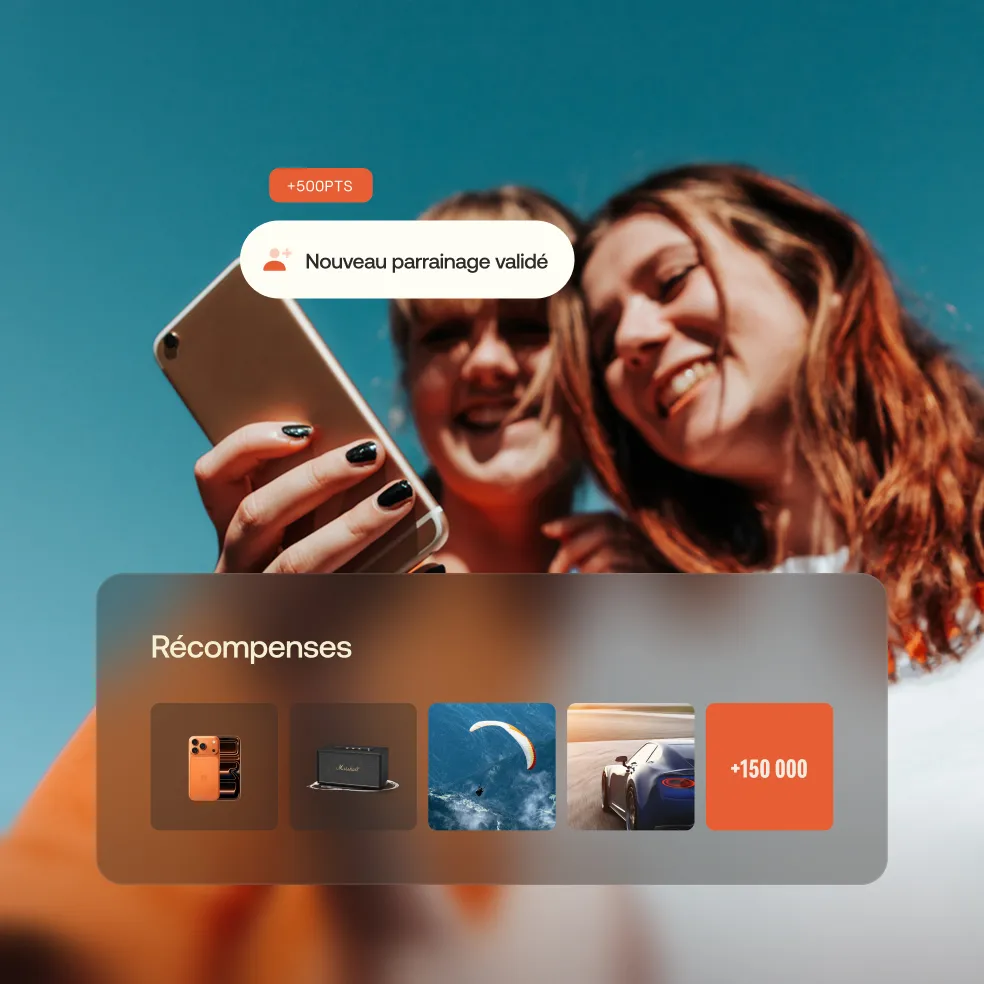
But not all challenges are created equal. Between overly complex mechanisms, poorly defined objectives and unmotivating rewards, many initiatives miss out on their potential. In this article, we look back at what a commercial challenge really is, why to implement it, and what mechanisms work best today, with concrete and actionable examples.
What is a commercial challenge?
A commercial challenge is a sales stimulation system, implemented over a defined period of time, which aims to encourage a target population to reach — or exceed — certain objectives.
He can contact:
- aux internal sales teams,
- To one network of resellers or distributors,
- To partners or prescribers.
Unlike traditional commissions or bonuses, the commercial challenge is based on a logic ofanimation : specific rules, targeted objectives, attractive rewards and regular communication.
The aim is not only to reward the best, but to make all participants progress, by directing their efforts towards strategic behaviors (selling a priority range, activating a channel, shopping cart, etc.).
Why set up a commercial challenge?
A commercial challenge meets several very concrete challenges.
Give a clear direction to teams
A good challenge makes it possible to make priorities legible: which products to grow, what objectives to achieve, over what period.
It transforms a commercial strategy into concrete actions on the ground.
Create a dynamic over a given time
Unlike a long-term program, the challenge introduces a concept of rhythm and urgency.
Over a few weeks or a few months, it makes it possible to concentrate the commercial effort and to obtain rapid results.
Engaging beyond top performers
Well thought-out mechanics aren't just for the top 10%.
They give everyone a chance to progress, through accessible levels, adapted goals and motivating rewards.
Measuring the impact of commercial actions
A well-structured commercial challenge makes it possible to precisely monitor participation, commitment and sales generated.
It then becomes a real control tool, and not a simple one-off operation.
Discover the ultimate guide to driving sales :
.webp)
Examples of challenges according to the business objective
An effective commercial challenge is not defined by a single mechanism, but by a coherent combination between objective, duration, animation and rewards.
Here's how businesses structure their systems when they want results.
Boosting sales over a key period
Objective : generate figures quickly (highlight, end of quarter, seasonal operation).
- Frequent mechanics: accumulation of points or trigger threshold
- Temporality: short (4 to 8 weeks)
- Key to success: simple, readable, achievable goals
- Animation: regular reminders, intermediate rankings
👉 Ideal for accelerating sales without setting up a long-term program.
Orient sales to a priority range
Objective : push a strategic product (new range, high margin, destocking).
- Frequent mechanics: bonus points on targeted products
- Temporality: medium (2 to 3 months)
- Key to success: clear difference between “standard” products and boosted products
- Animation: product focus, field reminders, educational messages
👉 The challenge becomes a tool for aligning strategy and field.
Engaging the entire network (not just the best)
Objective : increase global participation and collective impact.
- Frequent mechanics: progressive steps, personalized goals
- Temporality: medium to long
- Key to success: feeling of individual progress
- Animation: valorization of the steps taken, not only of the podium
👉 We're looking for “a little more from everyone”, not just an achievement by top performers.
The mechanics of commercial challenges
Cumulative point challenge
- Each sale earns points
- Points give access to tiers or to a rewards store.
- Very suitable for large and heterogeneous networks
👉 Mechanics simple, legible, effective over time.
Challenge with thresholds or triggers
- A reward is unlocked as soon as a threshold is reached
- The logic “effort → immediate reward”
👉 Very effective in triggering the first step into action.
Multi-criteria challenge
- Sales + training + activation of a tool or channel
- Objectives weighted according to business priorities
👉 Useful when you want to guide behaviors, not just volume.
How to structure a successful commercial challenge
A commercial challenge should never be thought of as an isolated event.
It is a fully-fledged commercial management tool, which must be integrated into a clear business logic.
Define a clear and prioritized objective
The first mistake is wanting to do it all at once.
An effective challenge answers to a main objective, clearly formulated and measurable:
- increase turnover over a given period of time,
- accelerate the sale of a strategic range,
- activate an under-exploited channel,
- engaging a low-active population.
A unique objective makes it possible to build a legible mechanism, to communicate effectively and to assess the real impact of the device.
Segmenting participants to maximize impact
Treating all participants the same way is rarely effective.
Segmentation allows:
- to adapt the objectives to the realities on the ground,
- to avoid the concentration of earnings on a minority,
- to significantly increase the participation rate.
The most frequent segmentations are made by:
- performance level,
- geographical area,
- type of customers or points of sale,
- seniority or commercial maturity.
The challenge is not perfect equality, but theperceived fairness.
Choose a duration consistent with the objective
Temporality directly influences engagement.
- Short challenge (4 to 6 weeks) : ideal for creating a peak of activity or supporting a high season.
- Intermediate challenge (2 to 3 months) : allows you to structure a progressive effort.
- Challenge Long : requires intermediate levels and sustained animation.
A good challenge is rhythmic: it is never only played at the beginning or at the end.
Plan a simple but regular animation plan
Animation is often underestimated, even though it determines the success of the device.
An effective plan is based on:
- clear launch communication,
- regular progress points,
- targeted reminders according to profiles,
- an emphasis on progress, not just final results.
Without animation, even the best mechanics quickly lose efficiency.
Follow the right indicators from the start
Management should not be a retrospective assessment.
When designing the challenge, it is essential to define:
- participation indicators,
- progress indicators,
- commercial performance indicators.
This monitoring makes it possible to adjust the system along the way and to objectify the results.
6. Awards & prizes: what really motivates
The reward is often seen as the core of the challenge.
In reality, It is the way in which it is integrated into the mechanics that creates motivation.
Choice, a powerful motivator
Offering choice automatically increases the perceived value of a reward.
Two participants can assign a very different value to the same prize.
Allowing choices — between products, experiences, worlds — makes the reward more personal and more engaging.
Perceived value vs real cost
Not all rewards are equal in terms of impact.
Some endowments generate:
- high emotional value,
- a lasting memory,
- an attachment to the brand,
without however representing a high cost for the company.
It's this gap between perceived value and real cost which makes a device economically efficient.
Products or experiences: a strategic choice
The products are often perceived as useful and reassuring.
Experiences, on the other hand, create emotion and a lasting memory.
In stimulation devices, experiences:
- reinforce commitment,
- differ from traditional premiums,
- generate a stronger memory impact.
The right choice always depends on the profile of the target and the objective of the challenge.
Aligning the reward with the target and context
A relevant reward is a consistent reward:
- with the profession of the participants,
- with the effort required,
- with the image of the company.
A misaligned endowment can discredit the entire system, even if the mechanics are well designed.
Rewarding progress, not just final performance
The most effective devices value:
- the steps taken,
- regular efforts,
- consistency over time.
This logic makes it possible to maintain commitment throughout the duration of the challenge and to avoid the “dropout” effect of intermediate profiles.
Common mistakes to avoid
Some mistakes come up systematically and strongly limit the effectiveness of commercial challenges.
- Rules that are too complex, difficult to understand or explain
- A lack of visibility for participants on their progress
- Unattractive endowments, perceived as banal
- A lack of animation during the challenge, which leads to a rapid loss of interest
A challenge must remain simple, legible and lively.
How to manage and measure the effectiveness of a challenge
A commercial challenge is only valuable if it is sized.
The most used indicators are:
- the Participation rate,
- The individual and collective progress,
- the incremental turnover generated,
- Thecommitment over time (repetition, consistency, duration).
This data makes it possible to adjust the device along the way and to objectify its real impact, beyond feelings.
How to go further with a stimulation platform
When devices multiply, the question is no longer “what to do”, but How to pilot effectively.
The most advanced companies rely on tools that allow:
- The centralization operations,
- one quick setup rules and targets,
- access to a catalog of various endowments,
- one clear and actionable reporting.
This approach makes it possible to gain coherence, responsiveness and performance across all the challenges deployed.
Contact us to build the commercial challenge that suits you
Don't let the efforts of your sales forces and partners fall back: engage them with clear incentive mechanisms and rewards that make a difference.
request a demoPrêts à booster vos ventes ?
Lorem Lipsum Pain Sits Amet, Conecteur adipiscing Elite. Suspend varius enim in eros elementum tristique. Suis cursus, mi quivera ornare, eros pain interdum nulla, tu commodo diam libero vitae erat. Aenean Faucibus nibh et justo cursus di rutrum lorem imperdiet. Nunc ut sem vitae rissus sad powder.
request a demo%20(10).png)
.webp)