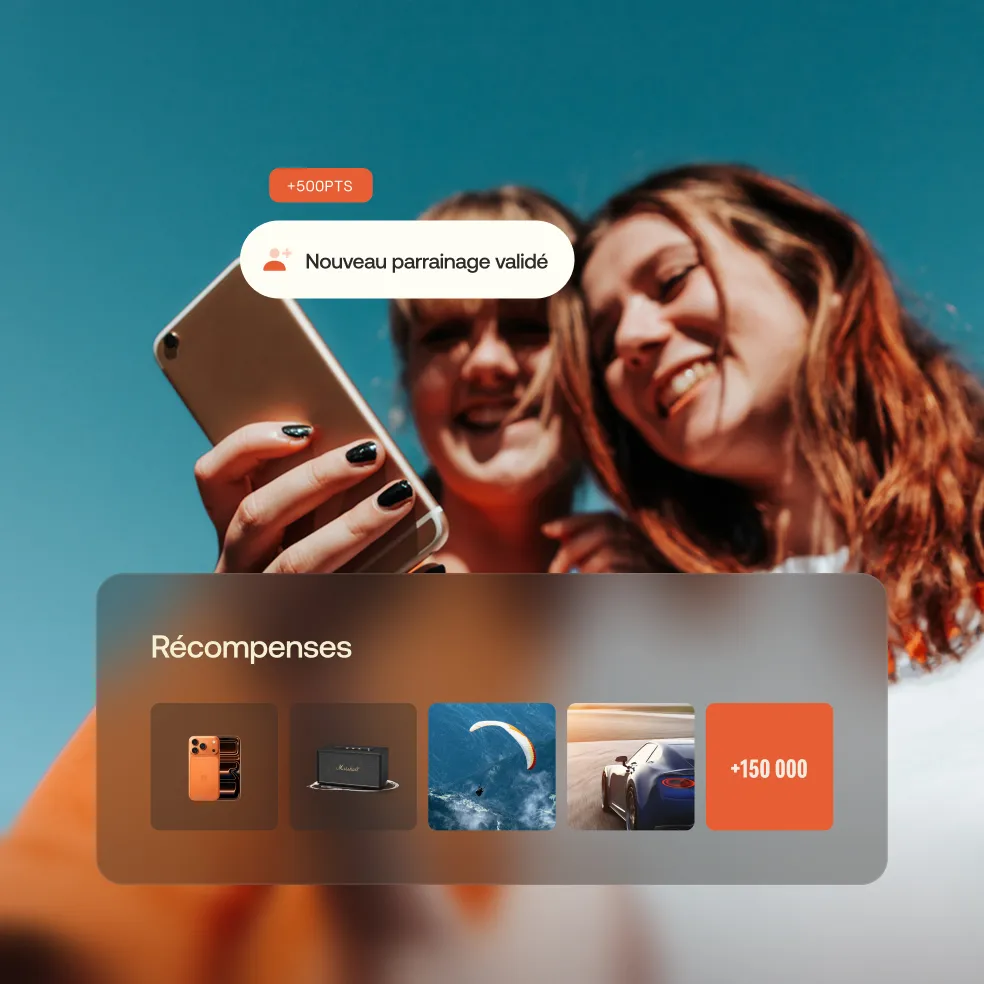
An incentive program is a strategic tool used to motivate sales teams, partners, or professional clients to reach specific goals. By combining rewards, stimulation mechanics, and ongoing engagement, it helps steer sales behaviors and accelerate growth. In this article, discover how to build a high-performing incentive program: definition, objectives, mechanics, rewards, engagement, and ROI management.
A truly effective incentive program rests on several pillars: a clear promise, understandable rules, benefits tailored to the target audience, regular engagement, and rigorous profitability management. A high-performing stimulation program is built as a structured framework, with a strong value proposition, earn-and-burn mechanics, continuous engagement, and constant attention to ROI.
👉 You can download our comprehensive guide to sales stimulation to discover in detail the best practices, mechanics, and strategies for designing a high-performing incentive program.
.webp)
What is an incentive program?
An incentive program is a system designed to motivate a target audience to reach specific goals in exchange for benefits or rewards.
The principle is simple:
- encourage extra effort
- guide behaviors
- reward performance
In practical terms, participants carry out specific actions (sales, referrals, goal progress, etc.).
These actions allow them to accumulate benefits that they can then exchange for rewards.
An incentive program can take several forms:
- sales contest
- points-based program
- sales competition
- stimulation program
- enhanced loyalty program
In any case, the logic remains the same:
create an incentive mechanism that aligns the interests of participants with those of the company.
Sales contest or incentive program: what is the difference?
These terms are often used interchangeably. However, they do not refer to exactly the same thing.
A Sales contest is often used to:
- boost a slow period
- support a product launch
- accelerate a campaign
The incentive program, on the other hand, is designed for the long term.
It structures the relationship with participants and creates a continuous engagement dynamic.
B2B vs. B2C incentive programs
Incentive programs exist for both B2C and B2B, but the underlying logic differs significantly.
In B2B, incentive programs are often more complex because they involve:
- multiple sales stakeholders
- corporate structures
- more specific sales targets
A good program must therefore be tailored to the reality of the sales network.
What is an incentive program for?
An incentive program is primarily used to align sales efforts with the company's strategic priorities.
Unlike a standard bonus, it allows you to:
- make goals visible
- build team momentum
- sustain motivation over time
Companies generally use incentives to achieve several goals:
- Increase sales
- Gain market share
- Successfully launch a product
- Expand product range depth
- Build customer loyalty
- Engage a network

The core idea remains the same: aligning participant interests with business goals.
Who are incentive programs for?
Before designing an incentive program, you must answer one essential question:
👉 who do you want to motivate?
The target audience influences:
- the objectives
- the rewards
- the mechanics
- the engagement strategy
An incentive program can target several different groups.
Boost sales team performance
For an internal sales team, an incentive program is a powerful tool to:
- maintain motivation
- clarify priorities
- recognize performance
A well-designed program also helps engage all profiles, not just the top performers.
Some best practices:
- set progressive tiers
- reward multiple performance levels
- make progress visible
Stimulating a network of resellers or distributors
In many B2B sectors, brands rely on resellers or distributors to sell their products.
The problem:
👉 these players often offer several competing brands.
An incentive program helps create a sales preference.
The program then becomes a lever to:
- guide recommendations
- reward sales efforts
- strengthen relationships with the network
Retaining professional clients
An incentive program can also be used to retain B2B clients.
In this case, it functions like an enhanced loyalty program.
It can reward:
- purchase frequency
- order volumes
- brand engagement
But it can go further by offering:
- premium services
- training
- exclusive benefits
- gamification
The goal is no longer just the transaction.
It is about building a lasting relationship with the brand.
How to build an effective incentive program
Setting up an incentive program cannot be improvised.
The success of the initiative relies on a few simple, yet often overlooked, fundamentals.
An effective program must answer several questions:
- What business goal should it serve?
- Who needs to be involved?
- What level of effort is expected?
- What reward is truly motivating for the target audience?
- How can engagement be sustained over time?
When a program fails, it is usually not because of the rewards. It is often because the mechanics are poorly designed or the objectives are poorly defined.
Here are the essential steps for building a high-performing incentive program.
Define clear and measurable objectives
Every incentive program must start with a simple question:
👉 What result do you want to achieve?
Without a clear objective, an incentive quickly becomes a simple reward scheme with no real impact.
Common objectives include, for example:
- increase revenue over a given period
- promote a new product line
- accelerate a product launch
- expand product range depth
- activate a reseller network
- acquire new customers
The ideal approach is to set goals that are simple and measurable.
For example:
- 15% increase in sales for a product line
- 200 new customers signed
- 20% growth across a distributor network
Clear objectives allow participants to immediately understand what is expected of them.
Adjusting the program duration
The duration of an incentive program depends directly on the objective being pursued.
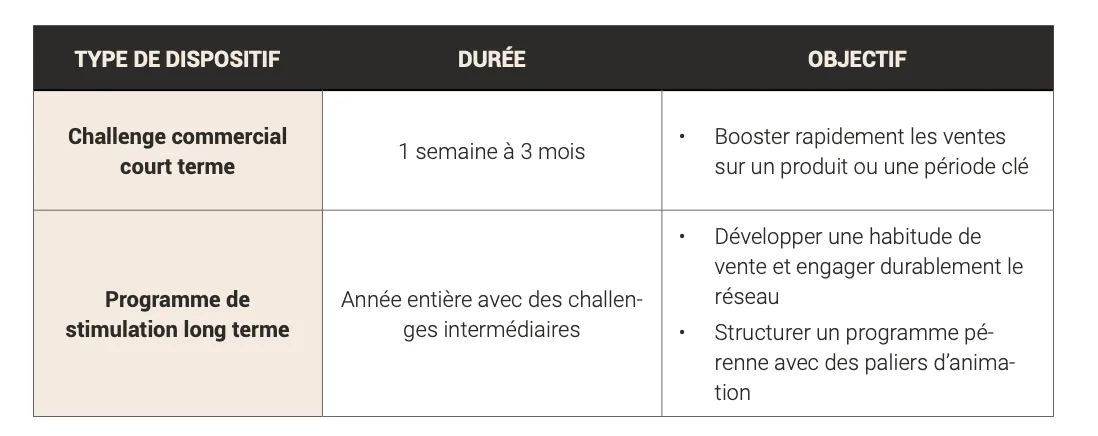
Some operations are very short:
- a one-month sales challenge
- a flash campaign to support a launch
- a product launch initiative
Other programs are designed for the long term:
- annual sales incentive program
- B2B loyalty program
- partner network engagement strategy
In any case, it is important to pace the program.
Even in a long-term program, it is recommended to include:
- interim challenges
- one-off bonuses
- key moments
These moments help boost engagement and prevent a drop in interest.
Building a motivating promise
The core of an incentive program lies in its promise.
In other words: what does the participant actually gain by getting involved?
The promise must meet three criteria:
1. It must be clear
The participant must immediately understand:
- what they need to do
- what they can win
Overly complex mechanics quickly discourage engagement.
2. It must be attractive
Rewards must be motivating enough to trigger extra effort.
This does not necessarily mean very expensive prizes. What matters most is perceived value.
3. It must be credible
Goals must remain attainable. If the reward seems out of reach, participants will quickly disengage.
A best practice is to provide multiple reward tiers, so that everyone has a chance to earn a benefit.
Which rewards should you choose for an incentive program?
The reward is often the most visible part of the program. However, it is not always what determines the success of the initiative.
What really matters is the alignment between:
- the reward
- the target audience
- the effort required
An ill-suited reward can diminish the program's impact, even if its monetary value is high.
Conversely, a relevant reward can drive strong engagement while keeping the budget under control.
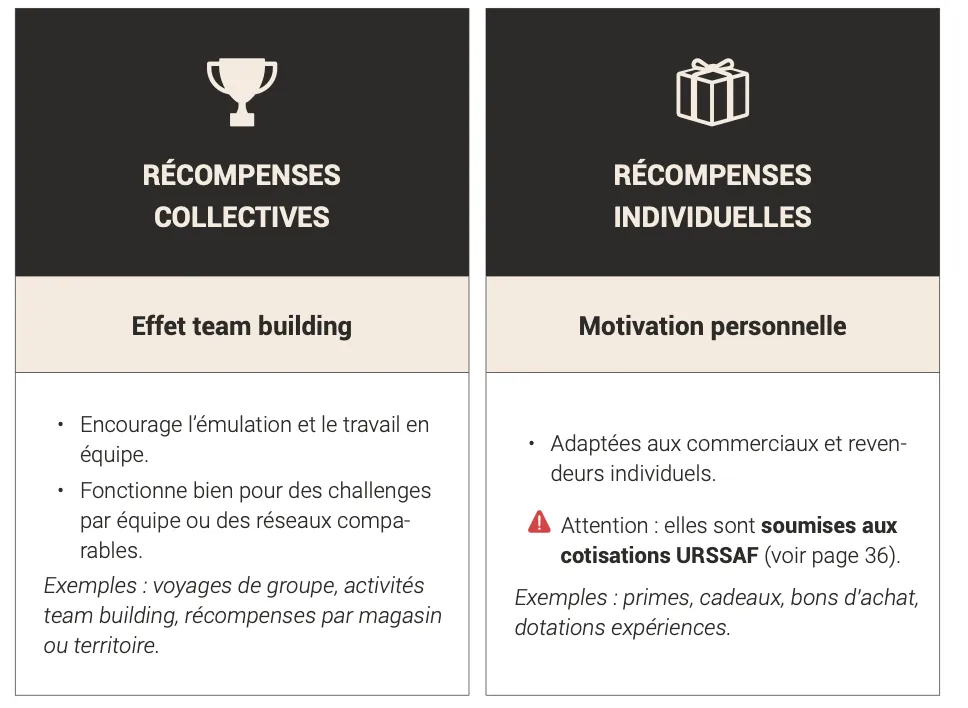
Financial rewards
Financial rewards remain widely used in incentive programs.
They can take several forms:
- bonuses
- gift cards
- gift vouchers
- euro accounts
These rewards offer several advantages:
- they are easy to understand
- they are easy to distribute
- they offer great flexibility in how they are used
However, they can sometimes lack an emotional connection.
Prizes and experiences
Experiences and prizes are often perceived as more memorable.
Examples include:
- getaways
- sports or cultural activities
- gastronomy
- exclusive events
- premium items
These rewards are particularly effective when you want to:
- create an emotional connection
- make a lasting impression
- recognize exceptional performance
They also help to strengthen brand loyalty.
Exclusive services and benefits
Some companies go further by offering benefits that streamline the professional activities of their participants.
For example:
- access to a dedicated customer service team
- priority technical support
- sales support
- marketing tools
- exclusive content
These benefits can be particularly relevant for programs aimed at partners or distributors.
Training and skills development
Training can also be part of an incentive program.
It helps to:
- value participants
- improve their expertise
- strengthen their sales capabilities
In certain technical or industrial sectors, these rewards are particularly valued.
Gamification
Gamification involves integrating game-based mechanics to boost engagement.
For example:
- badges
- levels
- rankings
- missions
- challenges
These mechanics help create a more playful dynamic and maintain interest over time.
Which mechanisms should you use in an incentive program?
An incentive program is based on a simple mechanism:
👉 participants perform actions
👉 these actions generate benefits
👉 these benefits are converted into rewards
Two concepts generally structure these programs.
The accumulation system: the “earn”
The earn corresponds to how participants earn their benefits.
Examples of rewarded actions include:
- sell a product
- reach a goal
- sign a new client
- recommend an offer
- take a training course
Several systems can be used:
- revenue-based scale
- points awarded per sale
- performance tiers
- bonuses on specific product lines
The goal is to create a system that is clear and motivating.
The conversion system: the “burn”
The burn refers to how participants use their benefits.
In many programs, participants accumulate points that they can then convert into rewards.
This system offers several advantages:
- it provides more freedom for participants
- it allows for a diverse catalog
- it makes budget adjustments easier
Participants can then choose their rewards based on their preferences.
Tiers and statuses
Tiers and statuses introduce a progressive dimension to the program.
For example:
- Silver level
- Gold level
- Premium level
Each level can provide access to additional benefits.
This approach strengthens engagement by introducing:
- a goal to reach
- status recognition
- visible progress
Challenges and boosters
To maintain the program's momentum, it is often useful to incorporate one-off activities.
For example:
- flash challenges
- bonuses on a product range
- temporary missions
- team competitions
These operations help to regularly boost engagement.
How to manage an incentive program over the long term
An incentive program does not run on autopilot.
Even with a solid structure and attractive rewards, engagement can quickly drop if the program is not regularly managed.
Engagement is often the factor that makes the difference between:
- a program that generates enthusiasm
- and a program that participants forget after a few weeks
To maintain motivation, it is essential to create a rhythm of interaction with participants.
Focus on the program launch
The launch is a key moment.
This is when the perception of the program is built.
A successful launch must:
- clearly explain the rules
- present the rewards
- inspire people to participate
Companies often use several levers:
- launch event
- internal communication
- dedicated emails
- introductory videos
- partner communication kits
The goal is simple: create momentum right from the start.
Maintain engagement over time
After the launch, the main risk is a drop in attention. To avoid this, it is important to keep the program active.
Several actions can be implemented:
- regular performance updates
- highlighting top participants
- goal reminders
- showcasing available rewards
These communications help maintain the program's visibility and remind participants of the value of staying engaged.
Use one-off activities
To revitalize momentum, it is often useful to incorporate one-off activities.
For example:
- short-term mini-challenges
- bonuses on specific product lines
- special assignments
- team-based competitions
These initiatives create key milestones within the program and help re-engage participants whose activity may have dipped.
Personalizing communication
The most effective programs also leverage personalization.
Not all participants have the same performance levels or expectations.
It is therefore relevant to tailor messages based on:
- performance level
- recent activity
- rewards already earned
For example:
- re-engage inactive participants
- congratulate top performers
- encourage those nearing a milestone
This approach helps to maintain higher engagement.
How to measure the profitability of an incentive program
An incentive program should be viewed as an investment, not just a marketing expense. The core question remains the same:
👉 what is the impact on sales performance?
A well-designed program must generate a measurable return.
Define a ROI target from the start
Even before launching the program, it is important to estimate:
- the expected additional revenue
- the margin generated
- the total cost of the program
This estimate helps determine whether the program is economically viable.
For example, a company might decide to invest a percentage of the expected additional revenue.
Tracking the right metrics
To measure the program's effectiveness, several indicators can be tracked:
- revenue growth
- change in sales volume
- participant activation
- engagement rate
- performance distribution
This data helps identify:
- the most active segments
- the top-performing products
- the most effective mechanics
Adjusting the program as needed
An incentive program is not set in stone.
It is often necessary to adjust certain parameters along the way:
- milestones
- bonuses
- rewards
- engagement activities
These adjustments allow you to progressively optimize the program's performance.
What is the legal framework for an incentive program?
Incentive programs are based on commercial and marketing mechanisms, but they also operate within a specific regulatory framework.
Depending on the program's target audience, certain obligations must be met.
For a complete overview of the regulatory framework, watch the replay of our webinar :
.webp)
Why digitize your incentive program?
Today, most incentive programs rely on a digital platform.
This approach offers several advantages.
Simplify program management
A platform allows you to centralize all information:
- performance tracking
- points accumulation
- rewards management
- communication with participants
This significantly simplifies program administration.
Improve the participant experience
Participants can:
- track their progress
- check their balance
- discover rewards
- access program information
This transparency boosts engagement.
Drive performance in real time
A platform also allows you to track the program's progress in real time.
This allows teams to:
- analyze performance
- identify trends
- adjust mechanics
This enables the gradual optimization of the system.
How to build a long-term successful incentive program
An effective incentive program relies on a balance between several elements.
To maximize your chances of success, it is important to:
- define clear objectives
- target the right audience
- offer relevant rewards
- build a simple structure
- manage the program regularly
- track performance and ROI
- comply with regulatory requirements
When well-designed and effectively managed, an incentive program can become a powerful driver of commercial growth.
In many B2B sectors, these initiatives help generate significant revenue growth while strengthening the engagement of teams, partners, and clients.
It is this combination of sales performance, engagement, and profitability that makes the incentive program a strategic tool for businesses today.
This is precisely the approach developed by RewardPulse.
The RewardPulse platform enables companies to design, launch, and manage high-performing incentive programs, whether they are aimed at:
- internal sales teams
- to reseller networks
- to distributors
- or to professional clients
By combining strategic support, a technology platform, and a rewards catalog, RewardPulse helps companies turn their incentive programs into true growth engines.
👉 If you want to implement a profitable incentive program tailored to your business goals, the RewardPulse team can assist you in designing and deploying your strategy.
Prêts à booster vos ventes ?
Lorem Lipsum Pain Sits Amet, Conecteur adipiscing Elite. Suspend varius enim in eros elementum tristique. Suis cursus, mi quivera ornare, eros pain interdum nulla, tu commodo diam libero vitae erat. Aenean Faucibus nibh et justo cursus di rutrum lorem imperdiet. Nunc ut sem vitae rissus sad powder.
request a demo.webp)