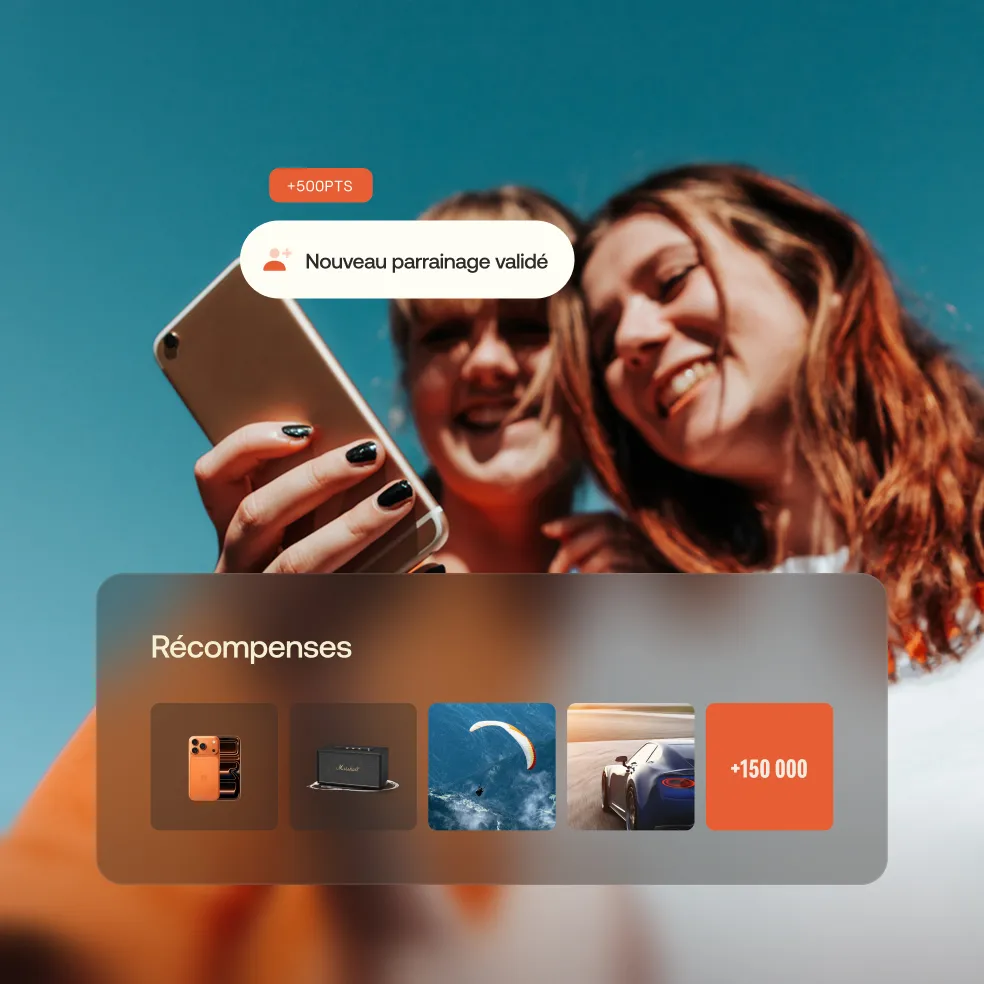
In a sales contest, the reward plays a decisive role in team engagement and achieving goals. It must be consistent with the effort required, tailored to the participants' profiles, and attractive enough to trigger a genuine sales push. In this article, we explain how to choose the right reward, the mistakes to avoid, and offer 20 prize ideas to design an effective sales contest.
The reward acts as an engagement lever. It transforms a sales goal into a concrete and motivating challenge.
A well-chosen reward for a sales contest can:
- trigger extra effort
- strengthen team engagement
- recognize performance
- create a positive dynamic within the sales organization
Conversely, an ill-suited reward can significantly reduce the impact of the contest, even if the goals are relevant.
So which reward should you choose for a sales contest?
Should you prioritize a financial bonus, a gift, an experience, or a trip?
In this article, we will look at:
- why rewards are essential in a sales contest
- how to choose the most motivating reward
- what are the best reward ideas to boost your sales teams
👉 You can download our complete guide to sales incentives to discover in detail the best practices, mechanics, and strategies for designing a high-performing incentive program.
.webp)
Why rewards are a deciding factor in a sales contest
In a sales contest, the reward is more than just a bonus.
It is the driving force of the initiative.
A contest is always based on a simple principle: asking sales teams to put in extra effort over a set period.
This effort can take several forms:
- increase sales of a strategic product line
- accelerate a product launch
- increase product penetration with a client
- reactivate dormant accounts
- acquire new customers
Without a strong incentive, this effort often remains theoretical. Sales teams tend to stay focused on their usual priorities: key accounts, easy-to-sell products, or their own individual targets.
Rewards therefore serve to create a favorable trade-off for the challenge.
Read also: 15 sales contest examples
Directing sales toward strategic priorities
The primary role of a sales contest is to steer sales efforts toward a specific business priority.
A very common example: a manufacturer wants to push a new, more profitable product line that is not yet selling well.
Without a specific initiative, sales reps will naturally continue to sell the products they already know and that sell easily.
A sales contest, paired with an attractive reward, helps shift this balance:
- specific bonus on the new range
- short-term challenge to boost initial sales
- dedicated reward for sales representatives who reach a target volume
The reward then becomes a sales steering tool.
Accelerating a product launch
Sales contests are also widely used during product launches.
When a company launches a new offering, several obstacles arise:
- sales teams are not yet familiar with the product
- customers are hesitant to try something new
- sales cycles can be longer
A challenge helps create an acceleration effect.
For example:
- reward for the first 20 sales
- bonus for sales reps who sign the first clients
- short-term challenge to quickly generate client references
In this context, the reward acts as a go-to-market accelerator.
Driving extra sales effort
In most sales organizations, annual targets are already set. Sales contests are generally used to drive extra effort, often over a limited period.
Let's look at a concrete example: a distributor wants to increase the product range depth among its artisan clients. Currently, most clients only buy two or three items.
The contest can then set a simple goal: sell at least five different items from the range during the period. The reward recognizes this specific effort.
In this case, the reward doesn't just recognize sales volume, but a specific sales behavior.
How to choose the right reward for a sales contest
In a sales contest, the question of the reward is often addressed too late. Yet, it should be considered from the very design of the program.
Rewards are not just what you give to the winners. They directly influence:
- the level of effort from participants
- the engagement rate in the challenge
- and ultimately the sales performance generated.
An effective reward must meet four criteria: alignment with the objective, suitability for the target audience, perceived value, and accessibility.
1. Align the reward with the challenge objective
The first question to ask yourself is simple: what sales behavior do you want to trigger? Because not all rewards produce the same effect.
A sales challenge can be used to:
- accelerate a product launch
- push a strategic product line
- acquire new customers
- expand the product range
- increase the average basket size
The reward must be proportional to the effort required.
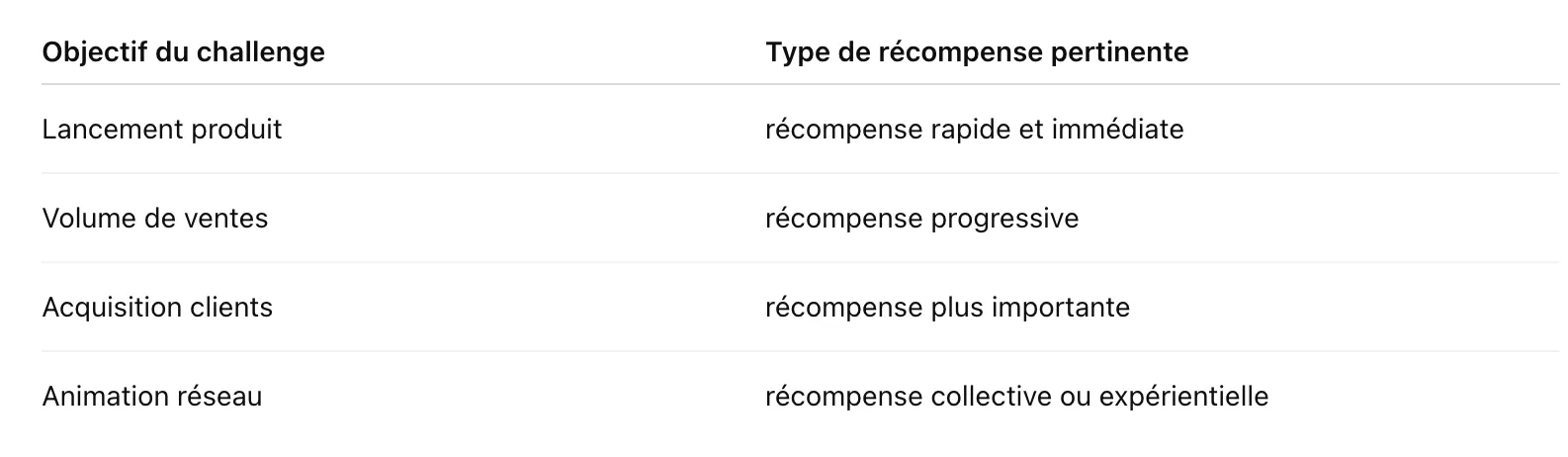
If the reward is too small compared to the effort required, teams will not change their sales priorities. Conversely, a well-calibrated reward can trigger a real sales acceleration effect.
2. Tailor the reward to the participants' profiles
A sales challenge does not always involve the same type of audience.
There are generally several scenarios:
- internal sales teams
- reseller sales forces
- distributor networks
- business clients
Expectations can vary significantly depending on the group.
For example:
- field sales representatives may be highly motivated by financial rewards or experiences
- Retail sales staff often prefer tangible rewards like high-tech gadgets or equipment.
- B2B partners are sometimes more motivated by team-based rewards or business-related perks.
Understanding your target audience helps avoid a common mistake: offering rewards that don't align with what participants actually want.
3. Focus on perceived value rather than cost
The budget for a reward doesn't always reflect its motivational power. What matters most is the value perceived by the participants.
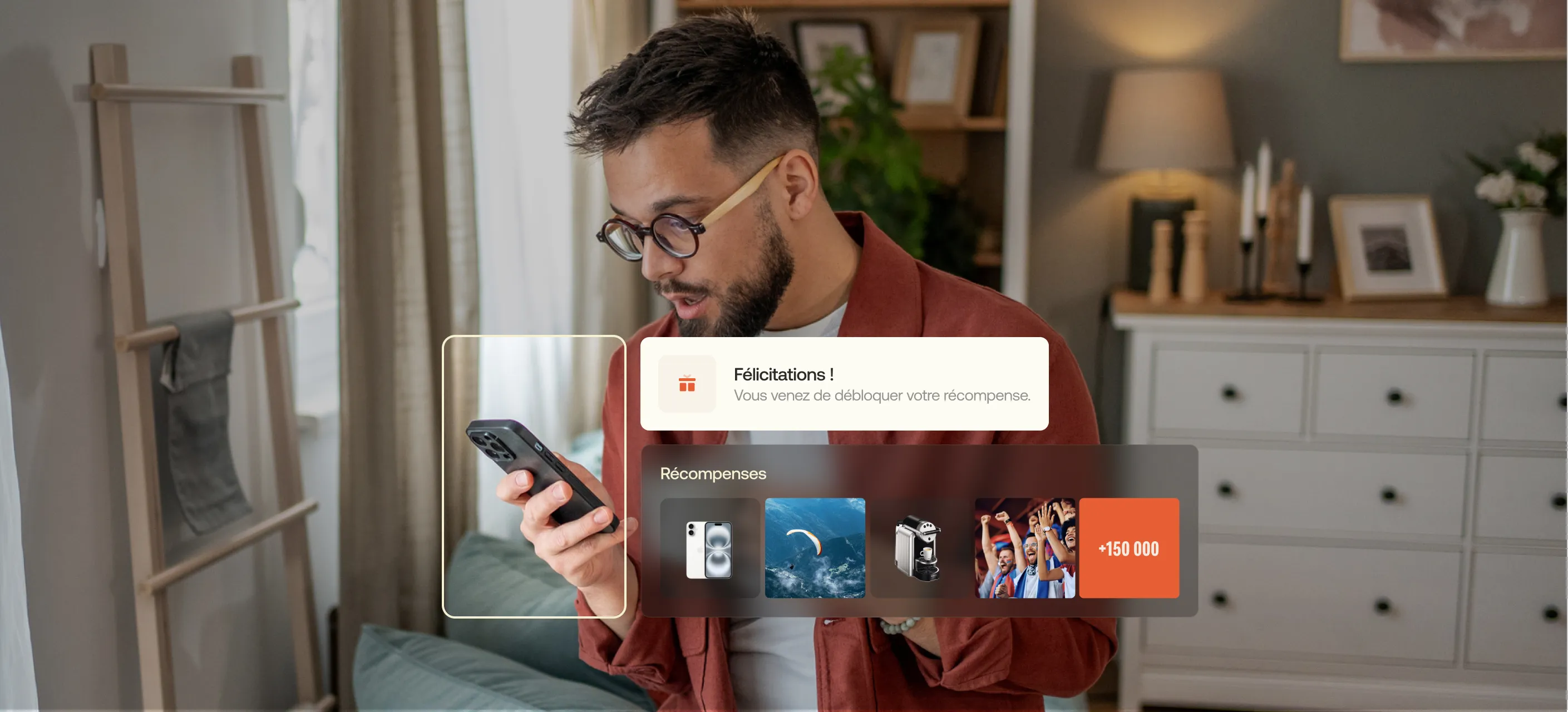
Some rewards can have a significant impact even when costs are kept under control:
- experiences
- events
- unique activities
- premium items
Conversely, purely financial rewards can sometimes be perceived as less memorable.
This is why many companies now prioritize experiences and customizable rewards, which create lasting memories and reinforce recognition for performance.
4. Make rewards accessible to maintain engagement
A common mistake is reserving rewards only for top performers. If a challenge is perceived as unattainable, a large portion of participants may quickly disengage.
To avoid this, it is recommended to structure the challenge with:
- multiple reward levels
- progressive milestones
- intermediate rewards

For example:
- a first level attainable by the majority of participants
- a second level for high performers
- a premium reward for top results
This approach helps maintain motivation across the entire group while still recognizing top performance.
5. Offer a choice of rewards
Finally, an increasingly popular approach is to offer a rewards catalog.
Rather than imposing a single reward, participants can choose the prize that best suits them.
This solution offers several advantages:
- each participant chooses what truly motivates them
- the perceived value is higher
- the program adapts to a wide range of profiles
Some specialized platforms provide access to a vast catalog of rewards, ranging from experiences and high-tech products to leisure activities, fine dining, or travel.
👉 This is the case, for example, with the RewardPulse rewards catalog, which offers a wide selection of experiences and rewards tailored to incentive programs.
This approach maximizes engagement while keeping challenge management simple.
20 reward ideas for a sales challenge
Choosing the right reward is one of the most important aspects of a sales challenge. An attractive reward can significantly boost team motivation and engagement, while an ill-suited one can diminish the challenge's impact. Companies typically use a mix of financial rewards, experiences, and exclusive perks to drive sales performance.
Here are 20 effective reward ideas to motivate your sales teams.
Financial rewards
Financial rewards remain among the most commonly used in sales competitions. They are easy to understand and offer participants great flexibility.
- One-time bonus for the top salesperson
- Multi-brand gift card
- Personal cash pot to use as you wish
- Salary bonus
- Special commission on specific sales
These rewards are particularly effective for short-term challenges or when aiming to hit a specific revenue target.
Memorable experiences and activities
Experiential rewards are often highly valued because they create a strong emotional connection. They also serve as a lasting way to commemorate the success of the challenge.

- Weekend getaway at a hotel or tourist destination
- Gourmet dinner for two
- Sports or adventure activity (paragliding, driving experience, etc.)
- Tickets to a sporting event or concert
- Cruise or unique experience
Experiences are often seen as more motivating than purely financial rewards because they create memories and strengthen commitment to success.
Premium gifts and products
Premium items are also very popular in sales challenges.
- Smartphone or high-tech gadget
- High-end headphones or earbuds
- Smartwatch
- Premium coffee machine
- Lifestyle accessory or tech gadget
These rewards work particularly well for individual challenges with a clear goal.
Travel and exceptional rewards
For the most ambitious sales challenges, some companies offer more prestigious rewards.
- City break in a European capital
- Relaxing spa or wellness retreat
- Incentive trip for top performers
Travel is often used to reward top performance and create an ultimate goal effect.
Team rewards
Challenges can also foster team spirit by offering collective rewards.
- Team building or group activities
- An evening or event for the entire sales team
This type of reward promotes cohesion and is particularly relevant when goals are collective.
Offer a rewards catalog to provide choice
Another approach is to offer a rewards catalog that allows participants to choose their own prize.
This solution offers several advantages:
- each participant chooses the reward that suits them best
- motivation is higher thanks to personalization
- the catalog can be adapted to different profiles and budgets
Specialized platforms like RewardPulse, for example, offer a catalog of over 200,000 prizes and experiences to suit all types of recipients: high-tech, gourmet, wellness, leisure, or travel.
Common mistakes to avoid when choosing rewards
In many sales contests, the problem isn't the goal or the mechanics… it’s the choice of rewards. Certain mistakes happen time and again and can significantly undermine the impact of your program.
❌ Choosing a reward that doesn't match the effort required
The reward must be proportional to the sales effort requested.
For example, if the contest goal involves:
- acquiring new customers
- selling a strategic product line
- significantly exceeding standard targets
then the reward must reflect that effort.
A reward perceived as too small will have little impact on sales team behavior. Participants will simply continue to focus on their usual priorities.
❌ Offering a one-size-fits-all reward for all participants
Another common mistake is offering a single, identical reward for all winners.
Sales teams are often made up of very different profiles:
- ages
- interests
- lifestyles
- family situations
A single reward will only motivate a portion of participants. This is why more and more companies are favoring systems that allow winners to choose their reward.
❌ Reserving rewards only for the top performers
A challenge that only rewards the winner can quickly lose its effectiveness. In practice, only a few participants then have a real chance of winning. The others may quickly disengage.
A more effective approach is to structure the challenge with:
- multiple reward levels
- performance tiers
- interim rewards
❌ Neglecting challenge engagement
The reward alone is not enough to maintain motivation. Even with an attractive prize, interest can wane if the challenge is not actively managed.
To maintain engagement, it is important to plan for:
- regular communications
- interim rankings
- goal reminders
- key highlights throughout the challenge
❌ Making the mechanics unnecessarily complex
Finally, a classic mistake is designing a challenge that is too complex. If the rules become difficult to understand, participants may quickly lose interest.
An effective sales challenge must remain simple:
- clear goals
- easy-to-read rules
- understandable rewards
Simplicity is often a key driver of engagement.
How to digitize reward management for a sales challenge
As sales incentive programs grow, managing them can become complex.
Between tracking performance, awarding prizes, and communicating with participants, marketing or sales teams can quickly find themselves overwhelmed by administrative tasks.
That is why many companies today choose to digitize their sales contests.
Centralize performance tracking
A digital platform allows you to track participant performance in real time.

Teams can specifically view:
- challenge progress
- individual performance
- team results
- goal achievement
This visibility increases transparency and makes managing the challenge easier.
Simplify reward distribution
The management of rewards can quickly become complex, especially as the number of participants grows.
A platform allows you to automate several steps:
- reward allocation
- points or reward management
- access to the rewards catalog
- winner reward selection
This automation reduces administrative burden and secures the process.
Offer more choices to participants
Incentive program management platforms also allow you to offer a rewards catalog.
Participants can then choose the reward that suits them best from a wide selection:
- experiences
- high-tech products
- hobbies
- fine dining
- travel
This approach increases the perceived value of rewards while catering to a diverse range of profiles.
👉 For example, the RewardPulse platform provides access to a catalog of over 200,000 rewards and experiences, which participants can choose directly online.
Driving challenge effectiveness
Finally, digitizing a sales challenge allows for better performance analysis.
Teams can track:
- participation rates
- sales trends
- the most popular rewards
- the challenge's impact on sales performance
This data helps refine future programs and progressively optimize sales incentive initiatives.
Setting up a truly motivating sales challenge
A sales challenge is about more than just setting a goal and promising a reward. To be truly effective, it must be designed as a comprehensive sales incentive program.
This involves:
- defining a clear business objective
- building a simple and transparent mechanism
- offering rewards tailored to your target audience
- maintaining engagement through regular updates
- tracking performance throughout the challenge
When well-designed, these initiatives can have a very tangible impact on business activity. For example, some incentive campaigns can generate between 15% and 30% in additional revenue, while strengthening the engagement of teams and sales networks.
However, the success of a challenge also depends on its operational execution. Tracking performance, managing rewards, engaging participants, or offering attractive incentives can quickly become complex.
That is precisely the purpose of RewardPulse.
RewardPulse supports companies in designing and managing high-performing sales incentive programs.
The solution combines:
- a digital platform to track performance and manage rewards
- a catalog of over 150,000 experiences and products suited to all profiles and budgets
- expert guidance to design programs aligned with business goals
The result: programs that are easy to deploy, engaging for participants, and manageable in real time.
Prêts à booster vos ventes ?
Lorem Lipsum Pain Sits Amet, Conecteur adipiscing Elite. Suspend varius enim in eros elementum tristique. Suis cursus, mi quivera ornare, eros pain interdum nulla, tu commodo diam libero vitae erat. Aenean Faucibus nibh et justo cursus di rutrum lorem imperdiet. Nunc ut sem vitae rissus sad powder.
request a demo.webp)