
Launching an internal sales incentive program requires mastering three often-underestimated dimensions: the legal framework (consent, terms and conditions, point management upon departure), optimizing social security contributions via professional-use allocations (eligibility conditions, depreciation periods, the 50% rule), and the platform's operational requirements to ensure long-term compliance.
Implementing an incentive program for your sales teams is a strategic decision. However, it is also an operation governed by precise legal, social, and operational rules that many companies discover too late, often during an URSSAF audit.
This article is based on the webinar "B2B Loyalty & Incentives: what you are allowed to do in 2026".
.webp)
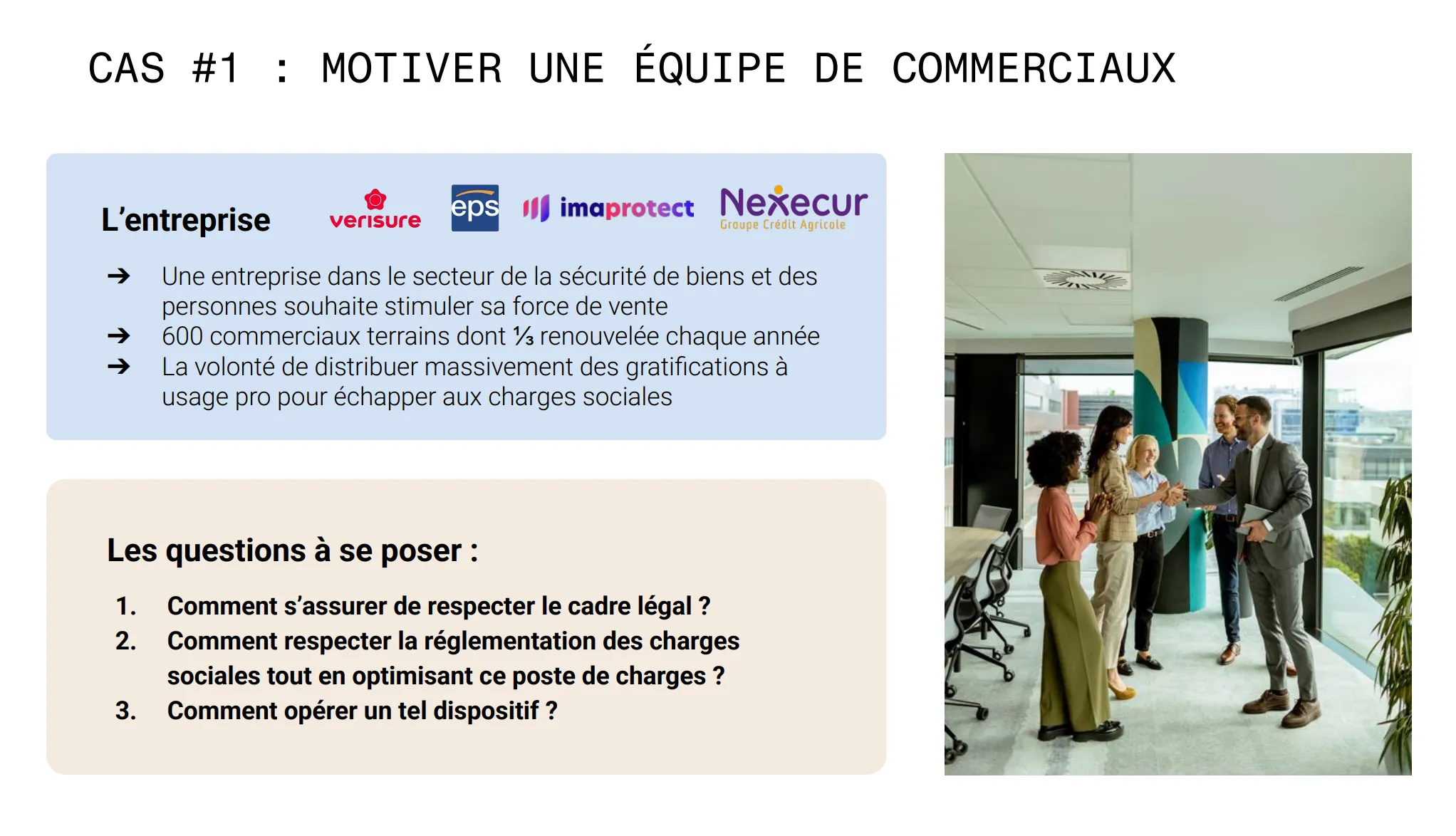
Imagine a company in the security sector with 600 field sales representatives, a high turnover rate, and a desire to distribute rewards on a large scale, for both professional and personal use. This type of setup immediately raises three questions: how to stay within the legal framework, how to optimize social security costs, and how to manage it all in practice? This is precisely what this article aims to unravel.
Consent: a non-negotiable prerequisite
Every incentive program involves collecting and processing participants' personal data: account creation, performance tracking, point history, and reward management. This data does not belong to the employer; it falls under the employee's personal sphere.
A direct consequence : before participating, the employee must accept the program's terms and conditions and provide explicit consent. In practice, this is done at the time of registration on the platform via a mandatory step: it is impossible to access the program without having accepted them.
This is not just an administrative formality. It is the essential condition for GDPR compliance and for avoiding any future litigation.
One often-overlooked point: what happens when an employee leaves the company with unused points? You cannot delete them simply because they are no longer an employee. The terms and conditions must provide for a grace period, generally three months, during which the former employee retains access to their account and can redeem their points. In a high-turnover sector like security, this is not a minor detail: it is a recurring issue that, if poorly anticipated, can generate real friction.
Professional-use allocations: a powerful optimization lever to be handled with care
This is the topic that raises the most questions and leads to the most errors. Professional-use allocations are exempt from social security contributions, making them a significant optimization lever. However, this favorable regime is subject to several strict requirements.
What is a professional-use allocation?
This refers to any asset used within the scope of the employee's professional activities:
- Phones, computers, headsets for calls
- Personal protective equipment for manual trades
- Any equipment specific to the industry sector
The common core is quite broad, but there are limits. Providing a computer to a field sales representative makes sense. Providing one to a bricklayer much less so, and a social security inspector will certainly point that out. The rule of thumb: the equipment provided must be directly related to the performance of the job.
Conditions to be met
Three points of vigilance are required:
- Professional equipment must be aligned with the employment contract. If the contract does not provide for this type of benefit, it will be difficult to justify its exemption from social security contributions.
- The contract must specify the depreciation period, i.e., the timeframe before the same equipment can be renewed (annually, every three years, etc.). This duration is verified during an audit.
- Each provision of professional equipment must be covered by a receipt signed and dated by the recipient. This document serves as proof that the rules have been followed.
The 50% rule
Professional-use equipment must not account for more than 50% of all rewards distributed within the program. Beyond this threshold, the risk of reclassification by the authorities becomes real, and the inspector will have every reason to scrutinize the entire system very closely.
Operability: what your platform must be capable of doing
Following the rules on paper isn't enough. You also need to be able to demonstrate compliance, individually, by award category, throughout the entire duration of the program.
Let's go back to our example. 600 field sales representatives, high turnover, and professional and non-professional awards distributed in parallel: without the right tool, management becomes unmanageable and compliance impossible to prove.
In practical terms, the platform must be able to:
- Track individual consumption history by award category
- Record and timestamp every consent and every benefit received
- Manage depreciation periods by award type and by recipient
- Maintain account access after an employee leaves, during the grace period provided for in the terms and conditions
Without these features, it is impossible to prove the program's compliance in the event of an audit.
Key takeaways
A poorly structured internal incentive program can expose the company to tax audits, disputes with current or former employees, and a loss of credibility with the teams.
Three pillars to keep in mind from the design stage:
- Consent and terms and conditions, established at registration and adapted to departure scenarios
- Professional awards, used with discernment and in compliance with thresholds and contractual conditions
- A platform capable of tracking, proving, and managing the entire system on an individual basis
It may not be the most visible part of an incentive program, but it is the one that determines whether you can justify it when someone asks.
That is precisely why RewardPulse designed its platform to handle these constraints natively: consent collection, timestamping of support, individual tracking of professional rewards, and account management after departure. From program design to long-term management, we support companies that want to effectively motivate their teams without taking on unforeseen risks.
Prêts à booster vos ventes ?
Lorem Lipsum Pain Sits Amet, Conecteur adipiscing Elite. Suspend varius enim in eros elementum tristique. Suis cursus, mi quivera ornare, eros pain interdum nulla, tu commodo diam libero vitae erat. Aenean Faucibus nibh et justo cursus di rutrum lorem imperdiet. Nunc ut sem vitae rissus sad powder.
request a demo%20(10).png)
.webp)