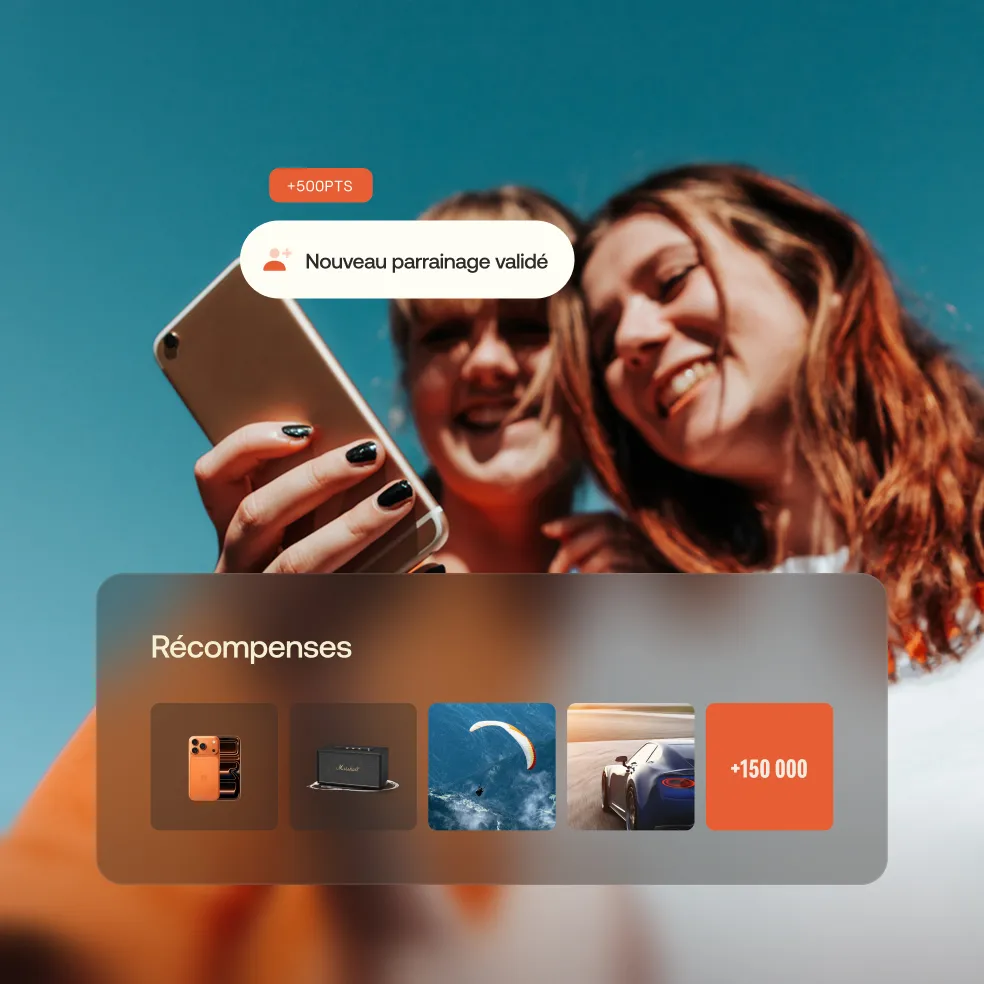
An incentive is a sales stimulation tool used to encourage extra effort in exchange for a reward. Primarily used with sales teams, it helps set priorities, accelerate sales, or push specific offers. When well-structured and managed, particularly through digital tools, it becomes a powerful driver of performance and ROI.
An incentive is not distributed just to "be nice," but to guide a decision or a sales effort. In sales organizations, it is a tool used continuously, often without being formally labeled as such.
👉 You can download our complete guide to sales stimulation to discover in detail the best practices, mechanics, and strategies for designing a high-performing incentive strategy.
.webp)
Incentives: definition and how they work
The term incentive refers to a simple mechanism: offering a reward conditional upon the completion of a specific action.
In a business context, it is primarily used to encourage extra effort, particularly among sales teams. This point is essential. An incentive does not replace a salary or a standard commission structure. It acts as a supplement to guide behavior over a specific period.
In most sales organizations, teams already have annual targets and an associated compensation system. However, these structures are not always enough to activate specific priorities. A salesperson will naturally focus their efforts on what they know, their regular accounts, or the easiest products to sell.
Incentives help break through this inertia.
They introduce an additional rule: a specific action—selling a product line, reaching a threshold, or signing a certain type of client—grants access to a reward. This reward shifts the salesperson's decision-making process. It does not create skill or build client relationships, but it does influence how effort is allocated.
In this context, an incentive always relies on three elements:
- a clearly defined action
- an explicit eligibility condition
- an associated reward
What makes it effective is not so much the nature of the reward, but the coherence of the whole. A well-designed incentive is easy to understand, attainable, and directly linked to a business objective.
Although the term is sometimes used broadly, it most often refers to internal programs: sales contests, sales stimulation campaigns, or one-off actions to support a launch or a priority. Incentives can also apply to external groups (resellers, partners, clients), but the logic remains the same: rewarding a targeted behavior to drive performance.
What is an incentive actually for
An incentive is not intended to reward "standard" performance. It is used to trigger an effort that would not occur spontaneously.
In a sales team, priorities are numerous and often competing. Between revenue targets, managing existing accounts, prospecting, and operational constraints, salespeople are constantly balancing their time and effort.
Incentives act precisely at this level.
It makes a priority more visible, more concrete, and above all, more engaging. When a goal is tied to a specific reward, it becomes more tangible. Salespeople are no longer working just to hit an overall number, but to achieve a clearly identified result within a defined framework.
This is particularly useful in several situations.
- When a company wants to promote a new offering, sales teams may be hesitant due to a lack of familiarity, longer sales cycles, or uncertainty about customer reactions. An incentive helps secure initial efforts and accelerates adoption.
- When it comes to developing a strategic product line, incentives help rebalance sales. Without them, salespeople often remain focused on the easiest products to sell, even if they aren't the most profitable.
- During phases where the goal is to boost overall performance over a short period, incentives create a sense of intensity. They provide a timeframe, a set of rules, and a reward that justifies extra effort.
- Finally, they can be used to drive more qualitative behavioral changes, such as diversifying a client portfolio, upselling, or selling associated services. In these cases, the incentive rewards not just volume, but the way of selling.
Beyond internal teams, this logic can be applied to other groups. Resellers, distributors, and business partners also have to make choices. When they distribute multiple brands or offerings, incentives help guide their recommendations.
Similarly, certain programs can target customers themselves by encouraging repeat purchases or increased volumes. Here again, the principle remains the same: a targeted action, a clear condition, and an associated reward.
In any case, an incentive works when it is used for what it truly is: a lever for activation, not a compensation tool.
The different types of incentives
In practice, incentives take very different forms depending on the context, the target audience, and the desired objective.
But behind this diversity, there are a few core principles.
The first distinction is between individual and collective incentives.
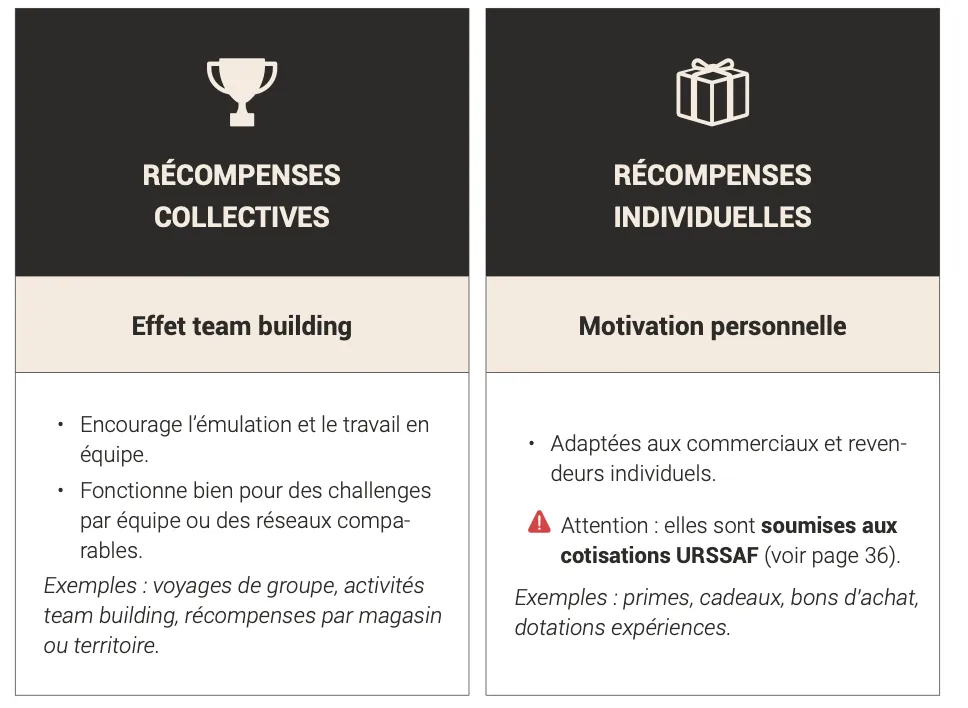
An individual incentive is based on each salesperson's own performance. It is particularly well-suited when objectives are clearly measurable and the goal is to foster individual accountability. This is the case for field sales teams or in environments where the client portfolio is well-structured.
Conversely, a collective incentive is used when performance depends on teamwork. It helps avoid excessive internal competition and encourages cooperation, especially in complex sales cycles or those involving multiple functions.
A second important distinction concerns timing.
Some incentives are built over very short periods: a few weeks or a quarter. They serve to create an acceleration effect, often focused on a specific goal (end of quarter, product launch, or sales campaign).
Others follow a longer-term logic, using accumulation or progression mechanics. These help maintain engagement over time and provide structure to efforts.
Finally, the type of reward plays a key structural role.
There are three main approaches:
- financial incentives, which are easy to implement but often lack differentiation
- non-financial incentives, based on gifts or experiences
- hybrid programs, which give the recipient a choice via a points system or catalog
This last model has become very popular because it allows rewards to be tailored to individual preferences while keeping the budget under control.
Discover the RewardPulse catalog :

Beyond these categories, what truly sets these initiatives apart is the quality of the mechanics. An effective incentive is always built on a simple rule, a clear objective, and a reward that matches the effort required.
Incentive programs: taking structure further
When incentives become recurring or target multiple groups, they become part of a broader strategy: the incentive program.

A program allows you to structure various actions over time:
- sales challenges
- one-off campaigns
- points-based systems
- ongoing engagement
It also provides a framework for tracking performance, monitoring results, and managing rewards centrally.
👉 To learn more about this topic, check out our dedicated article: Incentive programs: definition, examples, and best practices
This type of initiative is particularly relevant when:
- The objectives are manifold
- There are many different audiences (teams, partners, clients)
- Operational management becomes complex
This is often the stage where the question of tools and platforms arises.
What ROI can you expect from an incentive program
The question of ROI is central. An incentive is not a “motivation budget,” it is a commercial investment.
Its profitability is based on a simple principle: the additional revenue generated must exceed the cost of the program.
In practice, ROI depends on several factors.
The first is the quality of targeting.
A poorly targeted incentive (wrong audience, overly broad objective) dilutes its impact. Conversely, a program focused on a clear priority allows you to concentrate effort and achieve measurable results.
The second is the alignment between effort and reward.
If the reward is too small, it won't motivate anyone.
If it’s too large, it hurts profitability. It’s all about finding the right balance, often by working in tiers.
The third factor is the ability to monitor and adjust.
An incentive isn't set in stone. It needs to be tracked, managed, and sometimes recalibrated along the way to remain effective.
Finally, an often underestimated lever is optimizing the tax and social framework.
Depending on how rewards are structured (type, amount, frequency), the impact on total cost can vary significantly.
Well-designed incentive programs help achieve:
- accelerated sales over a specific period
- better focus for sales efforts
- increased revenue in priority areas
This is why it is a recurring lever used in sales organizations.
Provided you treat it for what it truly is:
a performance management tool, not just a reward.
Why digitize your incentives
As incentives multiply, managing them quickly becomes complex.
Tracking performance, calculating rewards, managing recipients, ensuring compliance—these tasks are often handled with fragmented tools: Excel files, emails, and manual tracking.
This approach quickly reaches its limits.
Digitization is not just about convenience. It becomes a lever to make incentives manageable, scalable, and measurable.
Gain reliability and transparency
An incentive is based on a rule.
If this rule is not applied rigorously, the credibility of the program is quickly called into question.

With manual management:
- calculation errors
- delays in awarding rewards
- misunderstandings about results
Conversely, a platform allows you to:
- automate performance calculations
- track results in real time
- ensure fairness among participants
Sales reps know exactly where they stand, what they still need to achieve, and what they can earn.
This visibility is a key driver of engagement.
Simplify operational management
Behind every incentive lies an operational reality that is often underestimated:
- participant management (multi-account, multi-user)
- reward allocation and distribution
- inventory or prize tracking
- request processing and support
Without the right tool, these tasks are time-consuming and create friction.
Digitization allows you to centralize these operations:
- a single point of entry for participants
- automated reward management
- a reduction in manual tasks for internal teams

This allows marketing and sales teams to focus on what matters most: strategy and engagement.
Structuring engagement and maintaining momentum
An incentive program relies on more than just its mechanics.
It also depends on how well it is managed over time.
Follow-ups, performance highlights, and results communication… Without active management, engagement quickly fades.
A digital platform helps structure this engagement through:
- automated notifications
- real-time leaderboard updates
- visibility into individual and team performance
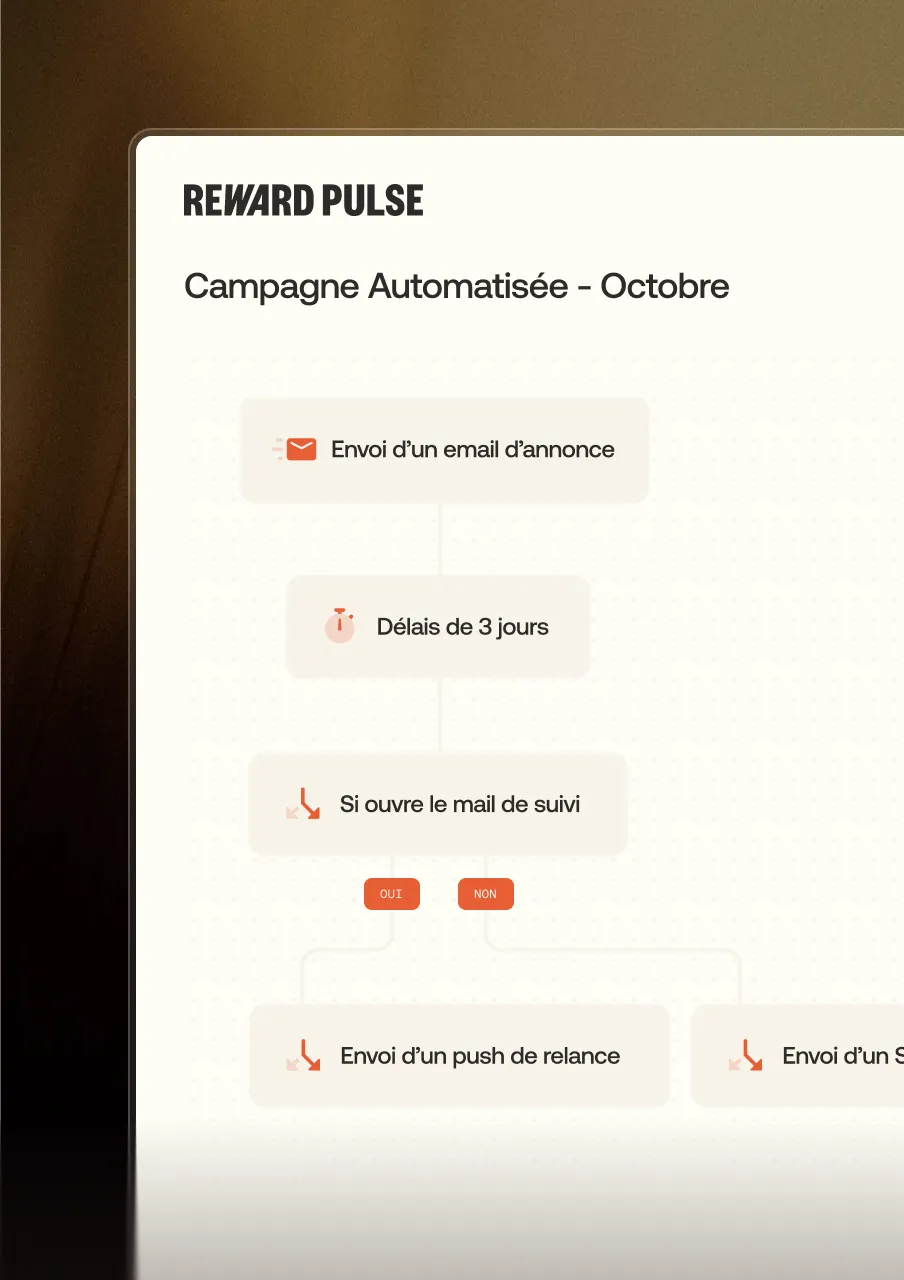
It transforms a one-off initiative into a continuous experience for participants.
Mastering regulatory and tax requirements
Managing incentives goes beyond just sales performance.
It also involves legal and tax obligations.
Depending on the situation:
- reporting bonuses
- monitoring thresholds
- distinguishing between allocations
- tracking consent
Manual management creates risks, such as errors, oversights, and difficulty providing justification during an audit.
A dedicated platform allows you to:
- track operations
- maintain data history
- structure management rules

This is a key factor, especially as volumes grow or multiple groups are involved.
Driving performance and measuring ROI
Ultimately, digitalization helps answer one essential question: does incentive programs actually work?
Without reliable data, it is difficult to measure:
- the impact on revenue
- changes in behavior
- the profitability of the program
A platform allows you to track:
- individual performance
- overall results
- associated costs

It provides a clear view of ROI and allows you to adjust programs over time.
Conclusion: making incentives a structured performance driver
Incentives are often seen as a simple tool: a reward in exchange for effort.
In reality, it is a much more structural lever.
When used correctly, it allows you to:
- align sales priorities
- accelerate sales
- to sustainably engage teams and networks
But its performance relies on three key elements:
- a clear mechanism
- tailored rewards
- rigorous execution
This is precisely where the difference lies between a one-off initiative and a true growth driver.
RewardPulse supports companies in this approach.
The solution allows you to design, deploy, and manage incentives centrally, with:
- a dedicated platform to track performance
- a broad and adaptable rewards catalog
- simplified management of rewards and recipients
The goal: to transform sales initiatives into structured, measurable, and profitable programs.
Prêts à booster vos ventes ?
Lorem Lipsum Pain Sits Amet, Conecteur adipiscing Elite. Suspend varius enim in eros elementum tristique. Suis cursus, mi quivera ornare, eros pain interdum nulla, tu commodo diam libero vitae erat. Aenean Faucibus nibh et justo cursus di rutrum lorem imperdiet. Nunc ut sem vitae rissus sad powder.
request a demo.webp)